

What Not to Fix When Selling a House (And What Actually Pays Off)
Selling your Colorado home means making smart choices about where to invest your time and money. Many sellers assume they need to fix everything before listing, but that approach rarely delivers the returns they expect. Working with Colorado sellers daily, we see thousands wasted on repairs that didn’t move the needle on final sale price. Our team applies the same data-driven approach, helping sellers align repairs with real buyer behavior and market conditions. Understanding what not to fix when selling a house in 2026 can save you significant time, reduce stress, and often net you more money than over-improving. Our home improvement ROI consulting helps Colorado homeowners make data-driven decisions about pre-sale repairs based on local market conditions, buyer expectations, and proven return on investment.
The Colorado market heading into 2026 shows balanced conditions with roughly 4.3 months of supply and homes averaging 68 days on market. Buyers have more options and negotiating power, but quality, well-priced homes still sell efficiently. This environment rewards sellers who focus resources on high-impact repairs while skipping projects that don’t deliver measurable value.
TL;DR
Smart Colorado sellers in 2026 are skipping expensive renovations that don’t recoup costs and focusing instead on essential repairs that affect safety, systems, and first impressions. With homes closing at roughly 5.7% below original list price and 70% of contract cancellations due to inspection/repair issues, the winning strategy is addressing critical systems, obvious neglect, and deal-breaking defects while leaving cosmetic imperfections, minor functional issues, and personal-taste upgrades for buyers to handle. Calculate your break-even point on every repair using local Colorado comps, prioritize exterior and curb appeal projects that typically exceed 100% ROI, and consider selling as-is when major capital repairs would cost more than the value they add.
Key Points
- ROI rules repair decisions: Entry door replacements return 194% ROI while major kitchen remodels recoup only 38% in 2026 Colorado markets
- Skip cosmetic fixes: Minor wall damage, outdated fixtures, worn flooring, and dated countertops rarely affect sale price when overall condition is sound
- Leave minor functional issues: Small plumbing fixes, minor electrical problems, driveway cracks, and older working appliances are buyer expectations in existing homes
- Avoid trendy or high-end upgrades: Partial renovations, niche amenities, and luxury finishes in starter neighborhoods consistently underperform
- Fix what kills deals: Critical systems, safety hazards, and obvious neglect must be addressed to avoid the 70% of cancellations from inspection issues
- Price beats perfection: Strategic pricing for condition, transparent marketing of potential, and targeting cash buyers often nets more than over-improving
Table of Contents
Why Major Pre-Sale Renovations Often Backfire
A Phoenix seller spent $70,000 on upgrades in 2024. New kitchen: $35,000. Bath renovations: $18,000. Flooring and paint: $12,000. Exterior work: $5,000. They expected to command top dollar. The home listed at $565,000 but sat for 70 days requiring two price cuts, finally selling at $510,000. The seller recovered only a fraction of renovation costs; net gain over a realistic as-is valuation of $475-485K was modest. Meanwhile, carrying costs mounted during extended market time.
This pattern repeats across cooling markets. Strategic pricing beats over-improving when inventory rises and buyer leverage increases. Colorado’s 2026 fundamentals show 30,803 statewide listings with prices flat year-over-year, creating conditions where “fix everything and price high” no longer works.
The ROI data confirms this shift. Garage door replacements deliver 188% returns while major kitchen remodels return 38%. Colorado buyers increasingly prioritize price and concessions over perfection. Statewide data shows homes closing at roughly 5.7% below original list price with average seller concessions around $8,000. This tells us buyers prefer value through price adjustments rather than demanding pre-closing repairs.
Why Kitchen and Bath Remodels Fail to Recoup Costs
Major kitchen and bath projects consistently underperform because costs rise sharply while buyers pay only moderately more. A minor kitchen remodel costing $27,500 adds about $26,400 in value (96-113% ROI). But a major kitchen remodel costing $80-85K adds only $32-40K (38-50% ROI). Once projects move from surface updates to structural changes, custom cabinetry, and high-end finishes, the economic equation breaks down.
The disconnect stems from three factors. First, over-improvement relative to neighborhood comps means appraisers can’t justify premiums beyond surrounding sales. A $150K chef’s kitchen in a $500K neighborhood returns about 38% of cost at resale because comps cap the value regardless of what you spent. Zillow notes kitchen remodels should “reflect the price point of your home”, as going beyond neighborhood norms limits ROI.
Second, layout changes and behind-the-walls work inflate costs without adding visible value. Moving plumbing sharply increases expense without comparably boosting perceived value. Buyers mainly see new cabinets, counters, and appliances. The same look a non-structural update delivers at far lower cost.
Third, personal design choices narrow your buyer pool. Trendy colors and excessive tile patterns turn into liabilities when tastes shift. Many buyers mentally add the cost to “fix” bold choices, reducing what they’ll pay. Neutral, timeless designs appeal broadly, while personalized spaces limit market appeal.
A Midwest seller in 2023 spent $25,500 on cosmetic upgrades. Interior repaint: $5,500. LVP flooring: $9,500. New fixtures: $2,000. Bathroom refresh: $6,000. Staging: $2,500. Post-work list price of $349,900 drew light traffic. After reductions to $334,900, the home sold at $330,000 after 45 days on market. Incremental gain over the as-is value of $315-320K was $10-15K, meaning the seller lost $10-15K on cosmetic investment.
How to Decide What Not to Fix Before Selling
Calculate Your Break-Even Point on Repairs
Run a simple two-scenario analysis before authorizing any repair work. Pull recent sold comparables and identify the minimum level of finishes those homes share. For each proposed repair, estimate the value lift using comps that match the improved condition, then subtract total project costs including labor, materials, and contingency. This same break-even framework is part of our consulting approach, where we help sellers model repair costs against realistic resale outcomes.
Set a clear rule: pre-sale work must recoup at least 90-100% of cost or solve a defect that materially hurts offers. Entry doors, garage doors, and neutral paint consistently hit that threshold. Custom kitchens and luxury baths rarely do.
Understand Your Local Market and Buyer Pool
Colorado’s 2026 market shows significant regional variation. Metro Denver listings average 36 days on market with modest year-over-year declines, while Pueblo shows 104 days on market with prices down 18%. Resort and mountain areas are shifting toward balanced markets with six months of supply.
Understanding your buyer pool matters equally. First-time buyers in starter neighborhoods prioritize affordability and often prefer to handle upgrades themselves. Move-up buyers expect updated kitchens and baths but not necessarily luxury finishes. Match your repairs to what buyers in your specific price bracket actually value.
Get an Agent’s Perspective Before You Start
Engaging a Colorado-focused agent early prevents costly missteps. Local MLS data, recent comparable sales, and direct buyer feedback identify which repairs attract offers and which waste budget in your specific neighborhood. Agents provide critical context that generic national ROI data misses. Whether your street commands premium pricing, how quickly competing listings are moving, which features buyers specifically request during showings.
Walk through your home with your agent and create a prioritized repair list based on financial ROI, marketability impact, and risk mitigation. Items scoring high across all three categories get immediate attention. Everything else waits or gets skipped entirely.

What to Skip: Cosmetic and Personal-Taste Fixes
Minor Wall and Paint Imperfections
Small nail holes, minor scuffs, or areas where paint color has faded slightly are non-issues for most Colorado buyers. Touch-up paint and basic patching can address obvious problems without requiring full repaints. Buyers understand homes have been lived in and expect minor wear. What they don’t tolerate is damage suggesting underlying problems. Large cracks indicating foundation issues, water stains pointing to roof leaks, or extensive damage suggesting deferred maintenance.
Outdated Fixtures and Hardware, Worn Flooring, Dated Countertops
Brass fixtures from the 1990s, builder-grade ceiling fans, dated cabinet hardware, worn but clean carpet, and laminate countertops fall into the “buyers will replace anyway” category. Most purchasers prefer selecting their own finishes. Minor kitchen remodels average 96% ROI while major remodels return only 38%, making seller-selected updates risky investments.
If carpet shows wear but no stains, tears, or odors, and hardwood has normal scratches but no structural damage, replacement typically isn’t necessary. Professional cleaning and minor repairs address the most common concerns without the expense of full replacement. Buyers planning to remodel kitchens themselves prefer lower purchase prices over materials they’ll immediately replace.
Minor Functional Issues Buyers Expect to Handle
Small Plumbing, Electrical, and Maintenance Items
Leaky faucets, slow-draining sinks, running toilets, loose outlets, and non-functional light switches in secondary rooms represent routine maintenance rather than deal-breakers. These repairs typically cost under $300 and buyers planning to stay accept weekend maintenance projects as part of homeownership. Inspection reports note these items but buyers rarely demand credits unless they indicate larger system failures.
The threshold shifts when small issues suggest bigger problems. Watch for patterns. Slow drains in multiple fixtures could signal main line issues, recurring toilet leaks might indicate flange damage, and low water pressure can point to galvanized pipe failure. Get a plumber evaluation before assuming it’s minor.
Driveway Cracks and Older Appliances
Small cracks in driveways and walkways are standard in Colorado’s freeze-thaw climate. As long as surfaces remain safe without trip hazards, cosmetic cracking doesn’t warrant pre-sale attention. Functional appliances from the 2000s or early 2010s remain usable even when dated. Buyers often prefer choosing their own appliances. Replacing working units represents sunk cost with minimal return.
Upgrades That Don’t Pay Off
Partial Renovations and Trendy Updates
Half-finished projects suggest either budget constraints or hidden problems discovered mid-renovation. Buyers discount heavily for incomplete work, often more than the cost to finish properly. Commit to complete renovations or leave spaces entirely as-is.
Bold paint colors, statement tile, ultra-modern fixtures, or farm-chic elements appeal to specific buyer segments while turning off others. Subjective, style-driven interior projects consistently underperform objective, curb-appeal-oriented work. Fashion-forward updates date quickly and narrow your buyer pool. Neutral, timeless choices maximize appeal across demographics.
Luxury Finishes and Niche Amenities
Installing luxury countertops, premium appliances, or high-end flooring in entry-level neighborhoods represents classic over-improvement. Sale prices are constrained by comparable properties, not by how much sellers spend. Appraisers adjust upward for quality but not dollar-for-dollar when improvements exceed neighborhood norms.
Pools rarely recoup installation costs in Colorado’s climate where the season is limited. Maintenance costs, safety concerns, and insurance implications deter many buyers. Other niche amenities face similar challenges. Elaborate landscaping, custom outdoor kitchens, specialized hobby spaces all have narrow appeal. These features should only be added for long-term personal enjoyment, never as pre-sale improvements.
When Light-Touch Preparation Works Better
A Northeast seller in 2024-2025 spent just $7,750 on strategic prep. Professional decluttering: $900. Deep clean: $650. Targeted paint: $2,200. Landscaping refresh: $1,000. Staging: $3,000. The home listed at $529,000 and received seven offers in the first weekend, selling at $545,000 after four days on market. Net improvement over as-is value: $17-22K on a $7.8K investment.
In relatively tight, mid-to-upper-mid markets, light, targeted prep often yields several-times ROI and short days on market, especially when combined with competitive pricing. The key is focusing on high-impact basics. Cleaning, decluttering, neutral paint in high-traffic areas, and staging key rooms rather than major renovations.
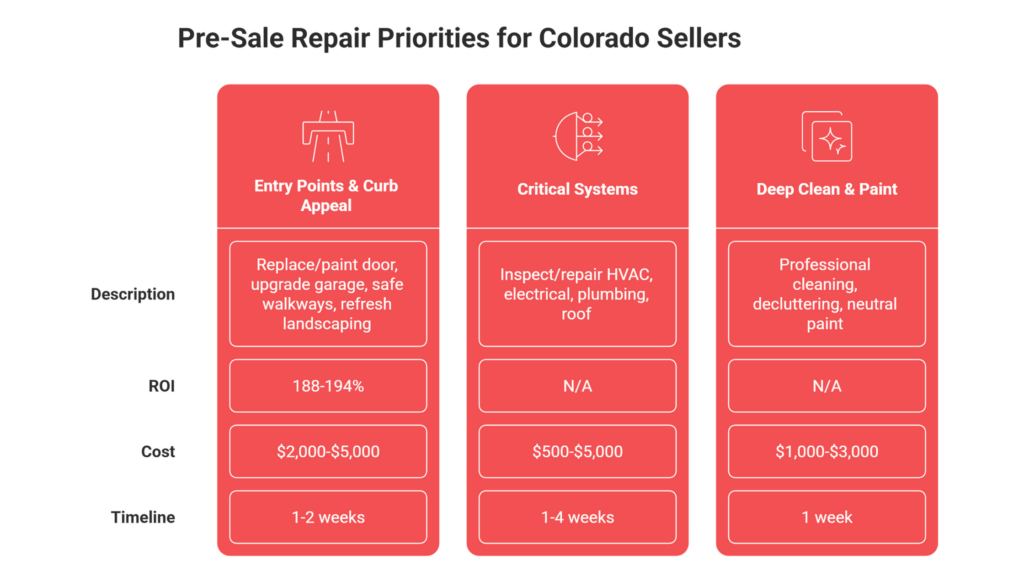
Top 3 Pre-Sale Repair Priorities for Colorado Sellers
- Entry Points and Curb Appeal Replace or paint the front door, upgrade garage door if damaged, ensure walkways are safe, and refresh landscaping. These projects deliver 188-194% ROI and create essential first impressions. Cost: $2,000-$5,000. Timeline: 1-2 weeks.
- Critical Systems Inspection and Repair Address HVAC, electrical panel, plumbing, and roof issues that will surface in buyer inspections. Roughly 70% of contract cancellations are due to inspection/repair issues, making proactive system maintenance essential. Cost: $500-$5,000 depending on findings. Timeline: 1-4 weeks.
- Deep Clean, Declutter, and Neutral Paint Professional cleaning, removing personal items, and applying fresh neutral paint in high-traffic areas costs little but dramatically improves buyer perception. Cost: $1,000-$3,000. Timeline: 1 week.
What You Must Fix: The Deal-Killers
Critical Systems and Safety Issues
About 15% of purchase contracts are canceling as of August 2025, with roughly 70% due to inspection/repair issues. That means approximately 10-11% of all under-contract deals fall apart over inspection problems. The top culprits: major roof problems, foundation and structural issues, water intrusion and mold, and aging HVAC, electrical, or plumbing systems.
Roof problems are repeatedly cited as one of the most common and costly deal breakers because they directly affect water intrusion and insurability. End-of-life shingles, active leaks, or damaged decking require attention. Costs range from $1,000-$4,000 for patch work to $10,000-$20,000+ for full replacement.
Foundation and structural problems disproportionately cause outright cancellations. Significant settlement cracks, bowed walls, or rot in load-bearing members are non-negotiable for buyers and lenders. Get a structural engineer report before listing and be ready to share it, plus a reputable repair bid. Minor crack injection costs $2,000-$8,000; major underpinning runs $15,000-$50,000+.
Water intrusion and mold reveal hidden damage and future problems. Chronic basement seepage, roof or window leaks, and visible mold create health concerns and remediation costs. Address active leaks, wet basements, and obvious mold before listing. Drainage improvements cost $1,000-$5,000; mold remediation runs $1,500-$5,000 for localized issues.
Aging systems near end-of-life should be evaluated. Non-functional HVAC at inspection is a common deal-killer. Unsafe electrical systems (Federal Pacific panels, knob-and-tube wiring, amateur work) can derail financing and insurance. Failing plumbing, especially sewer lateral issues in older neighborhoods, should be scoped and repaired proactively. Budget $4,000-$15,000+ for major system work.
Critical timing: Major system repairs take 1-4 weeks. Deep clean and paint take one week. Don’t start projects within three weeks of intended list date. Rushed work shows and raises buyer concerns.
Obvious Neglect and Deferred Maintenance
Peeling exterior paint, overgrown landscaping, broken windows, missing roof shingles, or clogged gutters signal neglect and cause buyers to assume other problems exist. These visual cues hurt first impressions and trigger more aggressive inspection scrutiny. Address visible maintenance issues systematically to ensure the property appears cared for.
Repair Priority Matrix | Must Fix | Consider Fixing | Skip or Disclose |
Critical Systems | HVAC failure, roof leaks, panel hazards | Aging furnace (5 years left), older water heater | Working but dated appliances |
Structural/Safety | Foundation cracks (active), deck failures | Driveway trip hazards | Minor concrete cracks, cosmetic deck wear |
Interior Cosmetic | Severe damage, water stains | Worn carpet (if stained/odor), broken fixtures | Dated finishes, minor wall damage, older but clean carpet |
Exterior/Curb | Failing siding, damaged roof | Peeling paint, dead landscaping | Older but functional garage door, dated shutters |
ROI Projects | Entry door, exterior paint | Minor kitchen refresh, garage door | Major kitchen remodel, luxury bath, pools |

When the As-Is Strategy Wins
A Charlotte seller in late 2023 faced $20-23K in roof ($11-13K) and HVAC ($9-10K) replacement quotes. Instead of doing the work, they spent $2,000 on basic cleaning and handyman fixes, then listed at $399,000. Slightly under pristine comps at $415K. The home received four offers in six days. Final contract: $410,000 with a $10,000 buyer credit for roof and HVAC, netting the seller $400,000. By disclosing issues and pricing competitively, the seller spent less than half the projected repair cost while selling quickly.
As-is sales work best when properties need major capital repairs where ROI is negative. Foundation work, extensive structural repairs, or full system replacements often cost more than the realistic value they add. Distress situations (inheritance, divorce, relocation) benefit from certainty of close even at discounts. With Colorado homes averaging 68 days on market, the predictability of cash buyers reduces ongoing carrying costs and eliminates deal-fallout risk.
As of late 2025, 55.7% of U.S. home sales closed under list price with median sale-to-list ratio of 0.989. As-is properties typically trade at larger discounts, but when repair costs are high and carrying time is long, net proceeds often favor as-is sales over attempted improvements.
How to Market a House That Needs Work
Price It Right and Highlight Potential
Colorado homes needing work must be priced using after-repair value minus realistic repair costs and buyer profit margin. Use a simple value summary showing ARV range, estimated renovation budget, and likely equity upside so buyers immediately see opportunity rather than just defects.
Market homes explicitly as fixer-uppers, renovation opportunities, or investor specials. Clear positioning filters out buyers seeking turnkey homes while attracting the right audience. Listings marketed as fixer-uppers receive 52% more page views than comparable older homes without that framing. Professional photos showing light, volume, and layout while honestly depicting needed work build trust and maintain realistic expectations.
Consider Cash Buyers and Investors
Colorado’s investor market remains active heading into 2026, with about one-third of single-family purchases made by investors. Cash buyers seek properties where straightforward work yields predictable returns. These buyers prioritize deal speed, clear title, and cooperative sellers over absolute bottom prices. Marketing directly to investor lists and local investment groups can generate quick closes even at discounts when your situation benefits from certainty and speed.
Making Your Final Decision on Pre-Sale Repairs
Colorado sellers in 2026 face a straightforward decision framework. Run two-scenario net sheets showing as-is proceeds versus post-repair proceeds minus costs. Only authorize repairs where the net gain is positive and the timeline fits your selling goals.
Prioritize repairs in this order: critical systems and safety issues that cause deal failures, obvious neglect that hurts first impressions, and high-ROI exterior projects like entry doors and garage door replacements. Skip cosmetic imperfections, minor functional issues, and upgrades that don’t recoup costs in your price bracket.
When major capital repairs push costs above 50% of current value with unclear returns, or when time constraints make renovation timelines unrealistic, shift to as-is marketing with strategic pricing and transparent condition disclosure. The Colorado market rewards honesty, proper positioning, and realistic expectations over attempting to hide defects or over-improving beyond buyer valuations.
Our selling a house in Colorado guide covers market timing, pricing strategy, and preparation tactics that maximize your proceeds in 2026’s balanced market conditions.
Conclusion
Understanding what not to fix when selling a house in 2026 protects your budget while positioning your Colorado home for competitive offers. Focus repair dollars on critical systems, safety issues, and high-ROI projects like entry points and curb appeal. Leave cosmetic imperfections, minor functional items, and personal-taste upgrades for buyers to handle themselves.
The Colorado market’s shift toward balanced conditions rewards strategic preparation over exhaustive renovation. Calculate break-even points, align repairs with your target buyer pool, and price appropriately for condition rather than attempting to compete with fully updated inventory through expensive improvements that won’t recoup costs.
Whether you’re considering targeted improvements, selling as-is, or evaluating the full range of options, we provide the clarity and local expertise you need to make smart choices. Contact us today to discuss your specific property and develop a customized selling strategy that aligns with your goals, timeline, and Colorado’s 2026 market realities.