

House Hacking Denver: Complete 2025 Investment Guide
House hacking transforms Denver homeownership into strategic investment, and JROC Properties has seen firsthand how this approach reshapes financial futures for Colorado buyers.This guide shows how house hacking denver works in 2025, financing, neighborhoods, and licensing. Living in one unit while renting others lets you cover mortgage payments with tenant income, building wealth while minimizing housing costs. Despite shifting market dynamics in 2025, Denver’s expanding job sectors and diverse housing stock create opportunities for informed investors who understand where demand remains strong.
Whether you’re exploring buying a home in Colorado for the first time or expanding your portfolio, understanding Denver’s unique landscape makes the difference between moderate returns and exceptional cash flow. Successful house hacking denver starts with conservative cash-flow math and location discipline.
TL;DR: House Hacking Denver in 2025
- Market Reality: Denver’s multifamily vacancy reached 11.5-12% with rents declining, but strategic opportunities exist in high-demand niches and suburban markets with limited new supply
- Entry Points: FHA loans require just 3.5% down with 580+ credit scores; VA loans offer 100% financing for military personnel with no mortgage insurance
- Prime Neighborhoods: Capitol Hill, Highlands, and Green Valley Ranch balance rental demand with accessible pricing for house hackers
- Legal Requirements: All Denver rentals require city licensing, inspections, and compliance with 2025 habitability laws—plan 2-4 weeks for approval
- Proven Results: Denver investors have eliminated housing costs entirely and built cash-flowing portfolios using multi-unit properties and room rental strategies
Timeline: Expect 3-4 months from research to tenant placement, accounting for licensing and inspection requirements
Table of Contents

What is House Hacking and Why Denver Works in 2025
House hacking means purchasing a property, occupying one portion as your primary residence, and renting the rest to offset your mortgage. You might live in one unit of a duplex while tenants occupy the other, convert a basement into a rental apartment, or lease spare bedrooms individually. This strategy reduces personal housing expenses to near-zero while building equity through homeownership.
The approach particularly appeals to first-time buyers who lack substantial capital but want investment returns. Because you occupy the property, you qualify for owner-occupied financing with lower down payments and better interest rates than traditional investment loans. Your tenants essentially fund your mortgage while you gain hands-on property management experience.
Denver’s economy drives consistent population growth through technology, healthcare, aerospace, and renewable energy sectors. This diversification stabilizes employment even during economic shifts, ensuring tenant demand remains steady. Young professionals and families relocating for career opportunities sustain rental interest across multiple property types, particularly in walkable neighborhoods near transit and employment centers.
The city offers housing variety matching different investment strategies—from Victorian-era homes with income-generating basements in Capitol Hill to modern fourplexes in Central Park. Options include classic duplexes, detached homes with ADU construction potential, and triplex or fourplex properties maximizing rental unit count within FHA financing limits.
Denver’s 2025 Market Reality: Strategic Opportunities Amid Shifts
Denver’s rental market in 2025 reflects both challenges and opportunities for strategic investors. Multifamily vacancy rates reached 11.5-12%, near record highs driven by over 18,000 new apartment deliveries since 2024. Average multifamily rent sits at $1,791 monthly, with rents declining 3.1% year-over-year through late 2024—the largest drop among major U.S. metros.
However, analysts project 0.8% rent growth throughout 2025 as construction completions drop sharply. Submarkets with limited new supply, including South Jefferson County and Northeast Adams County, show above-average performance. Active listings nearly doubled year-over-year to 12,000 by April 2025, the highest level since 2012, creating negotiation opportunities absent during peak years. For house hacking Denver, this environment favors buyers who can secure credits and rate buydowns.
JROC Properties observes that investors targeting high-demand niches, flexible layouts, and amenity-rich locations continue securing strong returns despite broader market softness. Properties in walkable neighborhoods near employment centers command premium rents and shorter vacancy periods. Single-family homes with additional units or room rental potential experience less downward pressure than large apartment complexes, particularly in suburban locations with constrained new supply.
Best Neighborhoods for House Hacking Denver
Capitol Hill blends walkability, cultural institutions, and relatively affordable entry points for urban Denver. Its mixed housing stock includes vintage homes with income-producing basements and smaller multi-unit buildings. The neighborhood attracts young professionals, students, and creative-class renters who value downtown proximity without premium pricing. Walkability and ADU-ready basements make Capitol Hill a staple for house hacking Denver.
The Highlands sustains strong demand through family-friendly parks, boutique retail, and historic character. Properties here command higher prices but deliver reliable rental income from tenants prioritizing quality schools and community amenities. Modern construction in nearby RiNo creates opportunities for investors targeting urban professionals through townhomes suitable for rent-by-room strategies.
Green Valley Ranch offers detached homes priced well below Denver averages, making it accessible for first-time house hackers. The neighborhood’s family orientation and newer construction appeal to renters seeking space and schools without urban density. Properties often feature layouts conducive to room rentals or basement unit conversions.
Central Park (formerly Stapleton) remains popular for families seeking master-planned community amenities, including parks, recreation centers, and retail. Single-family homes, townhomes, and duplexes provide various investment formats with strong rental demand from quality schools and convenient highway access.
Lakewood pricing runs slightly below core Denver, with proximity to mountain recreation and employment centers making it attractive for renters balancing affordability with lifestyle access. Properties often feature basements suitable for conversion to rental units, offering house hacking potential at accessible price points.
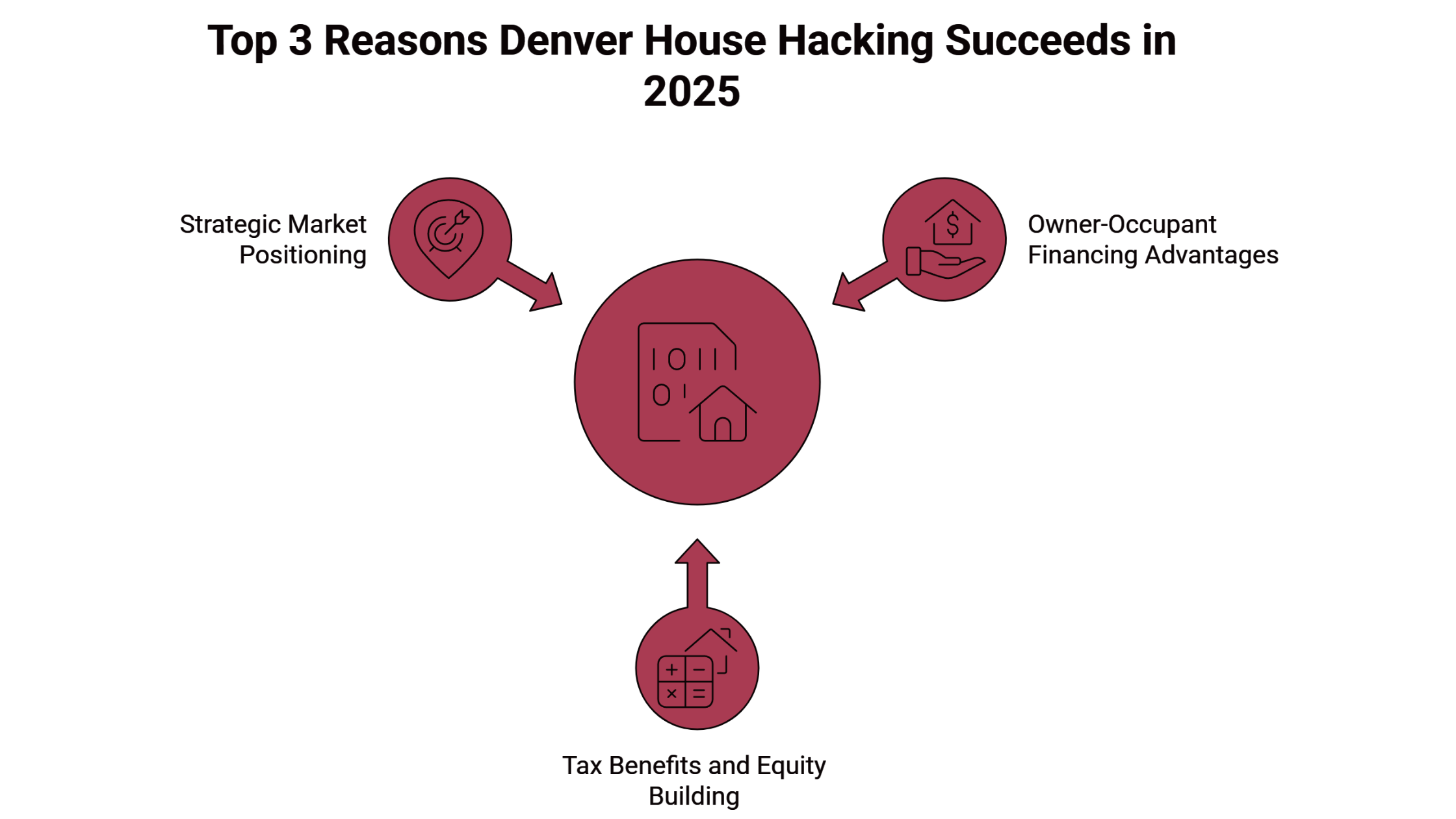
Top 3 Reasons Denver House Hacking Succeeds in 2025
- Owner-Occupant Financing Advantages: Living in your investment property unlocks FHA loans with just 3.5% down and conventional financing unavailable to pure investors, while tenant rent covers most or all mortgage payments from day one.
- Tax Benefits and Equity Building: Deducting rental-related expenses—including mortgage interest, property management, repairs, and depreciation—reduces taxable income while your tenants build equity through principal paydown.
- Strategic Market Positioning: Denver’s increased inventory and decreased competition empower buyers to negotiate favorable terms, identify value-add opportunities, and enter markets previously dominated by cash investors.
Financing Your Denver House Hack: 2025 Loan Options
FHA Loans: The First-Time House Hacker’s Entry Point
FHA loans revolutionize access for new house hackers, requiring minimum credit scores of 580 for the 3.5% down payment option. The 2025 conventional loan limit reaches $833,750 for single-family homes in Denver’s high-cost area, with multi-unit properties reaching $1,067,350 for duplexes, $1,290,200 for triplexes, and $1,603,400 for fourplexes.
You must occupy one unit as your primary residence within 60 days and maintain at least one full year of occupancy. Down payment funds can come from gifts or assistance programs, expanding options for buyers with limited savings. FHA loans require both upfront and annual mortgage insurance premiums, which increase monthly payments but enable entry with minimal capital.
VA Loans: Unmatched Advantages for Military Personnel
VA loans deliver exceptional benefits for eligible service members pursuing house hacking. 100% financing eliminates down payments, while no private mortgage insurance requirement reduces monthly payments substantially. Interest rates typically run 0.5% or more below conventional loans, significantly improving cash flow and overall profitability. Lower rates compound long-term returns for house hacking Denver.
The 2025 VA loan limit stands at $833,750 for Denver’s high-cost area, though veterans with full entitlement face no loan limits, providing greater buying power regardless of property prices. The program supports multi-unit properties up to four units, with borrowers occupying one as their primary residence. Service members can maintain multiple VA loans simultaneously, enabling portfolio growth using this benefit repeatedly throughout their careers.
Conventional Loans and Creative Strategies
Conventional financing for 2-4 unit investment properties typically demands 25% down payments, with investment property rates running 0.625% to 1% higher than primary residence financing. However, owner-occupied multi-unit properties qualify for standard conventional terms, making them significantly more affordable than pure investment purchases. Refi after rehab is a common path in house hacking Denver.
For properties needing renovation, hard money loans suit short-duration acquisition and rehab needs despite higher rates and fees. Successful investors use hard money for acquisition, complete renovations quickly, then refinance into permanent owner-occupant loans. Seller financing can circumvent strict credit or down payment requirements, with owners willing to carry financing sometimes accepting lower down payments or offering flexible terms.
JROC Properties maintains connections with investor-focused lenders who specialize in owner-occupied multi-unit financing and VA loan assumptions, providing creative solutions maximizing buying power for house hackers at all experience levels.
Proven House Hacking Strategies and Real Results
Traditional Multi-Unit Approach
Duplexes, triplexes, and fourplexes provide clear separation between your living space and rental units, maintaining privacy while generating income. Multi-unit properties qualify for owner-occupant financing, combining favorable loan terms with multiple rental incomes.
A Denver-based couple started with a fourplex, using the rental income to cover their mortgage entirely. They went from paying $1,500 monthly for housing to living for free, then expanded to additional properties. By using 5% down payments on subsequent purchases, they built increasing cash flow: $500 on their second property, $1,000 on the third, and $1,500 on the fourth. By 2023, their rental income surpassed their day job earnings.
Rent-by-the-Room Strategy
Individual room rentals maximize income from larger homes, particularly near universities, medical centers, or employment hubs. Four-bedroom homes generating room-by-room rents often produce substantially higher income than single-tenant leases.
A 4-bedroom property in Highlands or Capitol Hill generating $800 per room produces $2,400 monthly compared to $1,800 as a single-family rental—a 33% income increase. This approach demands more active management and thorough tenant screening to ensure compatible housemates, but young professionals, graduate students, and temporary workers seeking affordable options in desirable neighborhoods provide consistent demand.
Single-Family Homes with Basement Units
Converting basements into rental apartments offers privacy advantages over multi-unit buildings. Denver’s older housing stock frequently includes partially finished basements ready for rental conversion with modest investment. Separate entrances, bathrooms, and kitchenettes transform basements into legal dwelling units generating substantial income while you occupy the main living areas.
Verify zoning compliance, obtain necessary permits, and ensure proper egress windows meet safety codes before marketing basement units. Legal compliance protects your investment and prevents costly violations.
Short-Term Rentals: Limited but Viable
Denver restricts short-term rentals to primary residences where owners live at least 50% of the year. You must obtain specific licensing, Lodger’s Tax ID, and maintain $1,000,000 liability insurance, with license numbers displayed on all advertisements. These regulations limit pure investment STR strategies but allow hybrid approaches where you occupy the property part-time and rent short-term during absences. Properties near downtown, major attractions, or mountain access perform best for this model.

Finding and Analyzing Denver House Hacking Properties
Filter MLS searches specifically for multi-unit property types, including duplexes, triplexes, and fourplexes. Add keywords like “ADU,” “accessory dwelling unit,” “basement apartment,” or “finished basement” to identify single-family homes with income potential. Set bedroom and bathroom minimums at 4+ to identify larger homes suitable for rent-by-room strategies.
Target neighborhoods balancing strong rental demand with appreciation potential. Denver’s increased inventory creates negotiation opportunities—buyers can request seller credits, negotiate on price, or target properties with value-add potential that were too competitive previously.
Financial Analysis Framework
Denver’s elevated prices make the traditional 1% rule (monthly rent equaling 1% of purchase price) challenging. Many successful Denver investments perform at 0.7%-0.9% while still generating positive returns through appreciation and tax benefits. That’s the realistic band for house hacking Denver given current prices and taxes. Use conservative rental estimates based on actual comparable leases, not aspirational listings.
Calculate total monthly expenses including principal and interest, property taxes, insurance, HOA fees (if applicable), maintenance budget (typically 1% of property value annually), vacancy allowance (5%-10%), and property management (8%-10% of collected rent). Subtract expenses from projected rental income to determine monthly cash flow.
Comprehensive inspections identify potential issues before purchase. Denver’s insurance sensitivity to roof age makes condition verification critical, as newer roofs can reduce premiums by up to 75%, substantially improving cash flow. Confirm any basement or ADU conversions have proper permits, meeting legal and safety requirements for rental use.
Partner with JROC Properties’ investor-focused team for access to coming-soon listings, investment analysis, and transaction expertise specific to house hacking strategies.
Denver-Specific Legal Requirements and Compliance
All Denver residential rentals require licensing as of January 1, 2024, including single-family homes, condos, apartments, and duplexes rented for 30+ days. Applications cost $50 plus per-unit licensing fees, with licenses remaining valid for four years unless ownership changes. Licensing timelines matter for move-in and first-rent dates in house hacking Denver.
All properties must pass third-party inspections using certified inspectors from the city’s approved list. Inspections verify compliance with Denver’s minimum housing standards covering safety, habitability, and general upkeep. Common issues include missing smoke detectors, carbon monoxide alarms, improper egress windows, or electrical violations. Plan 2-4 weeks for licensing approval after inspection completion.
Colorado’s 2025 landlord-tenant laws strengthened habitability standards, requiring landlords to begin repairs within 72 hours after notification, with dangerous conditions demanding 24-hour action initiation. House Bill 24-1098 restricts evictions for tenants residing 365+ days to legally defined causes, while House Bill 24-1318 requires landlords to pay for reasonable disability-related modifications.
Understanding evolving Colorado tenant laws protects your investment while ensuring legal compliance. JROC Properties stays current on legislative changes affecting Denver landlords, providing guidance for navigating these requirements.
Property Management and Scaling Your Portfolio
Self-management offers hands-on control and eliminates management fees (typically 8%-10% of collected rent), but demands time and proximity to handle tenant issues. Professional management provides expertise in tenant screening, lease enforcement, and legal compliance, becoming essential as portfolios scale.
Colorado requires accepting portable tenant screening reports valid for 60 days, preventing duplicate screening fees. Apply uniform criteria—income minimums, rental history standards, and credit benchmarks—consistently across all applicants, ensuring fair housing compliance. Establish maintenance systems before tenant move-in, including 24/7 emergency contact methods and vetted contractor relationships.
After 12+ months of occupancy, leverage accumulated equity and rental income documentation to qualify for additional properties. Many investors convert initial house hacks into full rentals when moving to second properties, maintaining multiple streams of passive income. Understanding Colorado 1031 exchanges helps long-term planning when scaling portfolios or relocating equity between properties.

Common Mistakes to Avoid
Financial Miscalculations: Overestimating rental income or underestimating expenses creates negative cash flow and financial strain. Use conservative rent estimates from actual comparable leases, and budget comprehensively for vacancies, maintenance, capital reserves, insurance, taxes, and management fees. Properties barely breaking even in best-case scenarios often fail when reality intervenes.
Ignoring Legal Compliance: Failing to obtain Denver’s rental licensing, proper permits for basement conversions, or short-term rental regulations risks fines, legal action, and forced property sales. Research all applicable regulations before purchasing, budget for compliance costs, and maintain current knowledge as requirements evolve.
Poor Property Selection: Buying the cheapest property or focusing solely on purchase price over cash flow potential commonly derails house hackers. Prioritize high-demand rental neighborhoods with stable employment, good schools, and amenity access over absolute lowest prices. Properties in declining areas face chronic vacancies and tenant quality issues regardless of purchase discounts.
Getting Started: Your Denver House Hacking Action Plan
Begin by securing pre-approval from investor-friendly lenders, establishing realistic budget parameters and strengthening offers in competitive situations. Research target neighborhoods thoroughly, analyzing rental rates, vacancy patterns, and appreciation trends using current market data.
Assemble professionals including investor-focused real estate agents, experienced lenders understanding house hacking, contractors specializing in rental-ready renovations, and accountants familiar with rental property taxation. These relationships provide guidance, prevent costly mistakes, and accelerate success through their specialized expertise.
Plan 3-4 months from initial research through tenant placement, accounting for Denver’s licensing requirements, inspections, and approval processes. Budget for property improvements, compliance updates, and professional photography before marketing rental units. Realistic planning prevents financial gaps between purchase and rental income commencement.
Conclusion
House hacking transforms traditional homeownership into wealth-building strategy accessible to first-time buyers and experienced investors alike. Denver’s diverse neighborhoods, strong job market, and varied housing stock create multiple pathways for reducing housing costs while building equity. Though 2025 brings shifted market dynamics with elevated vacancy rates and moderated rent growth, informed investors who understand financing options, legal requirements, and property selection fundamentals can achieve substantial returns.
Strategic investors focus on high-demand niches, owner-occupied financing advantages, and properties in submarkets with limited new supply. The increased inventory and decreased competition create opportunities for negotiation and value-add acquisitions absent during peak market years.
JROC Properties brings decades of Denver market expertise helping house hackers navigate acquisitions, financing structures, and portfolio scaling strategies unique to Colorado real estate. Whether you’re exploring your first multi-unit property, converting a basement into rental space, or expanding beyond your initial house hack, the right guidance makes the difference between moderate results and exceptional financial outcomes.
Ready to start your Denver house hacking journey? Contact JROC Properties today for personalized consultation on properties and strategies matching your investment goals. Their team provides the market intelligence, professional connections, and transaction expertise that transform house hacking concepts into profitable reality.