

Colorado Real Estate Investing: How to Find Cash-Flow Deals Now
Colorado’s real estate landscape has matured considerably. The frenzied bidding wars and cash-dominated transactions of recent years have given way to something more measured and strategic. For investors willing to do their homework, 2025 presents genuine opportunities—not the get-rich-quick variety, but the kind built on solid fundamentals and disciplined analysis.
The state’s appeal hasn’t diminished. Migration continues, jobs keep coming, and the lifestyle draw remains powerful. What’s changed is the environment. Active listings jumped 18% for single-family homes and 21% for condos year-over-year, giving investors actual negotiation power. Stabilized mortgage rates around 6.5-7% have filtered out speculative buyers, leaving serious investors with breathing room to make informed decisions.
For investors weighing risk versus reward, Colorado real estate investing now favors preparation, patient underwriting, and partnerships with trusted local experts like JROC Properties.
TL;DR: Colorado Real Estate Investing 2025
Colorado real estate investing in 2025 is less about speculation and more about execution. With stabilized rates, balanced inventory, and stronger tenant demand, disciplined investors can secure positive cash flow and long-term growth across markets like Denver, Aurora, and Colorado Springs.
Key Points
- Market shift:Inventory up ~20%, creating real negotiation leverage.
- Top metros:Denver for value-add, Aurora for entry price, Colorado Springs for stability.
- Returns:Typical cash-on-cash yields range from 6–9% with 3–5% appreciation.
- Financing:DSCR & traditional loans remain viable—expect 20–30% down.
- Risk factors:Rising insurance and compliance costs; mitigate via proper underwriting.
- Strategy:Focus on cash flow first, appreciation second—use conservative projections.
Connect withJROC Propertiesto evaluate your next Colorado investment.
Table of Contents

Why Colorado Real Estate Investing Remains Strong in 2025
Population Growth and Economic Drivers
Colorado’s population momentum continues to fuel housing demand. The state’s 2025 population is projected at 6,013,650, maintaining its position as the 20th most populated state. Growth concentrates where investors want it—along the Front Range corridor. Counties like Douglas saw an 11% increase since 2020, while Weld jumped 14%. El Paso County added 2.6% to its population base.
The median household income of $92,470 gives Colorado residents genuine purchasing power, while the 9.38% poverty rate sits below national averages. These aren’t families stretching to make rent—they’re households that can sustain lease agreements and weather economic bumps. Tech, aerospace, and military sectors provide diverse employment anchors, with wage growth estimated at 4% and unemployment hovering around 3.5%.
Market Conditions Favoring Investors
Brandon Rearick, a Realtor in Northern Colorado, observes that “the inventory shortage that defined 2020–2024 is finally easing,” though he notes Fort Collins leads with 2.8 months of inventory while Windsor remains tighter. He adds that “with mortgage rates stabilizing in the 6.5–7% range, buyers are adjusting expectations,” and crucially, “cash offers now represent only18% of transactions, down from 35%. This shift gives financed buyers a fighting chance.”
The Denver Metro Association of Realtors notes that “January 2025 witnessed a notable increase in new listings across the Denver metro area and statewide, suggesting increased seller activity after a prolonged period of stagnation.” However, they emphasize that “affordability remains a concern due to persistently high mortgage rates and elevated home prices,” with median single-family home prices experiencing 1–2% seasonal dips before year-end rebounds.
Statewide, the median price for single-family homesfell just over 1%to $590,000 as of July 2025, while condos dropped almost 6% from 2024. Properties averaged 53 days on market, up 15% compared to last year. This balanced environment rewards preparation—you can conduct proper inspections, run real numbers, and walk away from deals that don’t work.
Top Colorado Real Estate Markets for 2025
Denver Metropolitan Area: Urban Core Opportunities
Market Fundamentals and Investment Metrics
Denver remains Colorado’s economic engine, though dynamics have shifted. The multifamily sector continues showing strength, particularly in older properties with value-add potential. High renter percentages create consistent demand, but smart investors now focus on suburban pockets rather than downtown high-rises. Among Colorado real estate investing hubs, Denver, Aurora, and Colorado Springs lead the pack for accessible entry points and steady rental yields.
A recent Denver investor implemented a room-by-room rental strategy with a5-bedroom single-family homepurchased at $610,000 in 2024 new construction. Using a 20% down payment and 6.8% conventional fixed-rate loan, they rented rooms for $900–$1,000 each, achieving total gross rent of $4,800–$5,000 monthly. Net monthly cash flow reached $1,200–$1,500, with annualized returns exceeding 9%. The challenges? Management complexity handling multiple tenants and neighborhood resistance to high occupancy.
Short-term rental portfolios in Denver show similar promise but face regulatory uncertainty. Single-family homes and condos operated as STRs typically purchase at $400,000–$550,000, using conventional loans with20% downor house hacking via FHA at 3.5% down. Average annual revenue hits $48,700 based on $180 nightly rates and 74% occupancy, with typical net cash flow of $12,000–$20,000 after debt service and expenses. Investors note seasonality affecting cash flow and increased cleaning costs.
Best Neighborhoods for Investors
Cap Hillattracts young professionals seeking rental housing close to downtown, delivering consistent demand despite shorter lease durations. RiNo pulls creative professionals with gallery districts and mixed-use projects reshaping former industrial zones. Properties command premium rents but require higher entry capital.
Stapleton offers family-focused opportunities with average lease durations hitting 2.8 years. Top-rated schools make the neighborhood sticky for tenant retention.Berkeleyrepresents emerging opportunity, with historic homes mixing with new construction. Cherry Creek caters to luxury renters through high-end retail, walkability, and executive housing.
Emerging neighborhoods like Montbello and Green Valley Ranch offer cap rates of 5.5-6.5% due to lower purchase prices and rising rental demand. Cash flow opportunities compensate for modest appreciation.
Expected Returns and Growth Projections
Denver’s long-term fundamentals remain sound despite near-term volatility. The Denver Metro Association of Realtors reports that the metro area has seenmodest price appreciationof 4% year-over-year, fueled by tech sector growth and inbound migration. Investors should expect appreciation in the 3-5% range rather than double-digit runs. Cash flow takes priority—buy properties that generate returns from day one.
Aurora: Affordable Entry Point with Strong Appreciation
Market Fundamentals and Investment Metrics
Aurora provides accessible entry points without sacrificing growth potential. The city offers diverse housing stock from single-family homes to small multifamily properties, creating opportunities across price ranges. Proximity to Denver keeps commuters engaged, while Aurora’s own employment centers reduce dependency on metro dynamics.
A 2024-2025 Aurora fix-and-flip investor documented strong returns despite market challenges. They purchased a 1970s single-family home at $390,000, invested$65,000 in renovations, and used hard money financing at 12% interest with 2 points upfront. After six months, they sold for $540,000, achieving gross profit of $85,000 and net profit of $40,000 after fees and costs. Challenges included construction delays from contractor shortages and slowing suburban price appreciation in late 2024.
Best Neighborhoods for Investors
East Colfax stands out for affordability and appreciation potential. The neighborhood’s diversity creates housing demand across tenant types, while public transportation access keeps commuters connected. Properties requiring light renovation can yield strong returns as ongoing revitalization lifts values.
Aurora Highlands brings suburban appeal with urban convenience. Master-planned community status means maintained amenities and established governance. Murphy Creek combines newer housing stock with recreational amenities centered around its golf course community, reducing immediate maintenance demands.
Southlands benefits from rapid growth momentum and property type diversity. Strong school districts create stable, long-term tenant bases. Southlands Mall anchors retail access, while mixed housing options let investors match strategy to budget.
Expected Returns and Growth Projections
Aurora’s trajectory favors patient investors building rental portfolios. Steady 4-6% annual appreciation paired with solid cash flow creates sustainable returns. The affordability gap between Aurora and Denver maintains the city’s value proposition for cost-conscious renters and investors seeking better cash-on-cash returns.
Colorado Springs: Military Stability and Tech Growth
Market Fundamentals and Investment Metrics
Military presence provides Colorado Springs with economic ballast other markets lack. Fort Carson and Peterson Air Force Base create consistent housing demand immune to tech sector volatility. Service members need housing, and their employment stability makes them attractive tenants.
Colorado Real Estate School notes that “Colorado Springs is poised to be the most competitive real estate market in the state in 2025, with a projected27.1% year-over-year increasein home sales.” The median price sits at$473,500, essentially unchanged from 2024.
A recent buy-and-hold investor purchased a single-family home at themedian price of $446,256, using conventional financing with 20–25% down at approximately 7% interest. Median rent of $1,557 monthly generated average annual cash-on-cash return of 1.4%, with long-term appreciation up 92% since 2000. Projected rent growth exceeds 2.5% for 2025. Challenges included tight cash flow from high purchase prices and rising mortgage rates, plus maintenance costs increasing around 10% in 2024.
Best Neighborhoods for Investors
Briargate ranks among the city’s most stable investment zones. Average gross rental yields range from6-8%for single-family homes. Proximity to Interquest and Northgate business parks connects tenants to growing tech employment. Excellent schools reduce tenant turnover.
Banning Lewis Ranch delivers rental yields of7-9%thanks to modern construction and competitive rental rates. Located along Powers Corridor, the neighborhood positions renters near defense industry offices and emerging tech employers.
Old Colorado City offers6-7% yieldssupported by demand for character-rich rental units. The historic downtown location connects commuters to Fort Carson and Peterson Air Force Base while providing access to west-side tech startups. Ongoing revitalization increases property values.
Pine Creek caters to upscale renters with yields around6%. Higher property values target military officers and aerospace executives. Bordering the Air Force Academy makes it highly desirable for personnel associated with the Academy and aerospace contractors.
Expected Returns and Growth Projections
Colorado Springs combines current income with growth trajectory. Military stability ensures base demand while tech sector expansion creates upside potential. Investors can expect rental rate increases of 4-6% annually as population growth continues outpacing new construction.
Fort Collins: University Market with Consistent Demand
Market Fundamentals and Investment Metrics
Colorado State University anchors Fort Collins’ rental market with predictable, recurring demand. The student population creates natural turnover cycles, but the city’s economic diversity extends beyond campus. Tech companies, breweries, and regional employers attract non-student renters, preventing over-reliance on university housing.
Fort Collins saw3% annual appreciationthrough recent data, reflecting steady rather than explosive growth. Brandon Rearick notes that Fort Collins inventory “sits at about 2.5 months of supply,” with Fort Collins specifically leading at 2.8 months.
A recent house hacking investor purchased a duplex near Colorado State University at the median market price of $504,339, using an FHA loan with 3.5% down. Average gross rent of $1,865 monthly per unit generated total annual cash flow of $8,000–$14,000 for investor-occupied duplexes. Occupancy remained very stable due to student demand, though challenges included high upfront costs, turnover aligned with academic calendars, and competition from other house hackers.
Key Investment Considerations
Seasonal dynamics affect student housing differently than family rentals. August lease-ups dominate the student market, while professionals and families rent year-round. Investors should align property types with target tenants—smaller units near campus for students, single-family homes in established neighborhoods for families.
Local regulations deserve attention. Fort Collins has implemented rental licensing and inspection requirements, with costs and compliance timelines affecting operating budgets. Property management becomes more valuable in university markets where turnover can consume owner bandwidth.
Emerging Markets Worth Watching
Markets beyond the Front Range offer investors seeking higher cash flow and lower competition interesting alternatives. Grand Junction and La Junta present opportunities for those willing to accept smaller tenant pools in exchange for better purchase prices and cap rates.
These markets attract attention as Colorado’s housing affordability crisis pushes residents toward cheaper alternatives. Remote work enables professionals to relocate entirely, bringing income from expensive metros to affordable towns. Risk profiles differ substantially—market liquidity drops, local expertise becomes critical, and exit strategies require more patience.
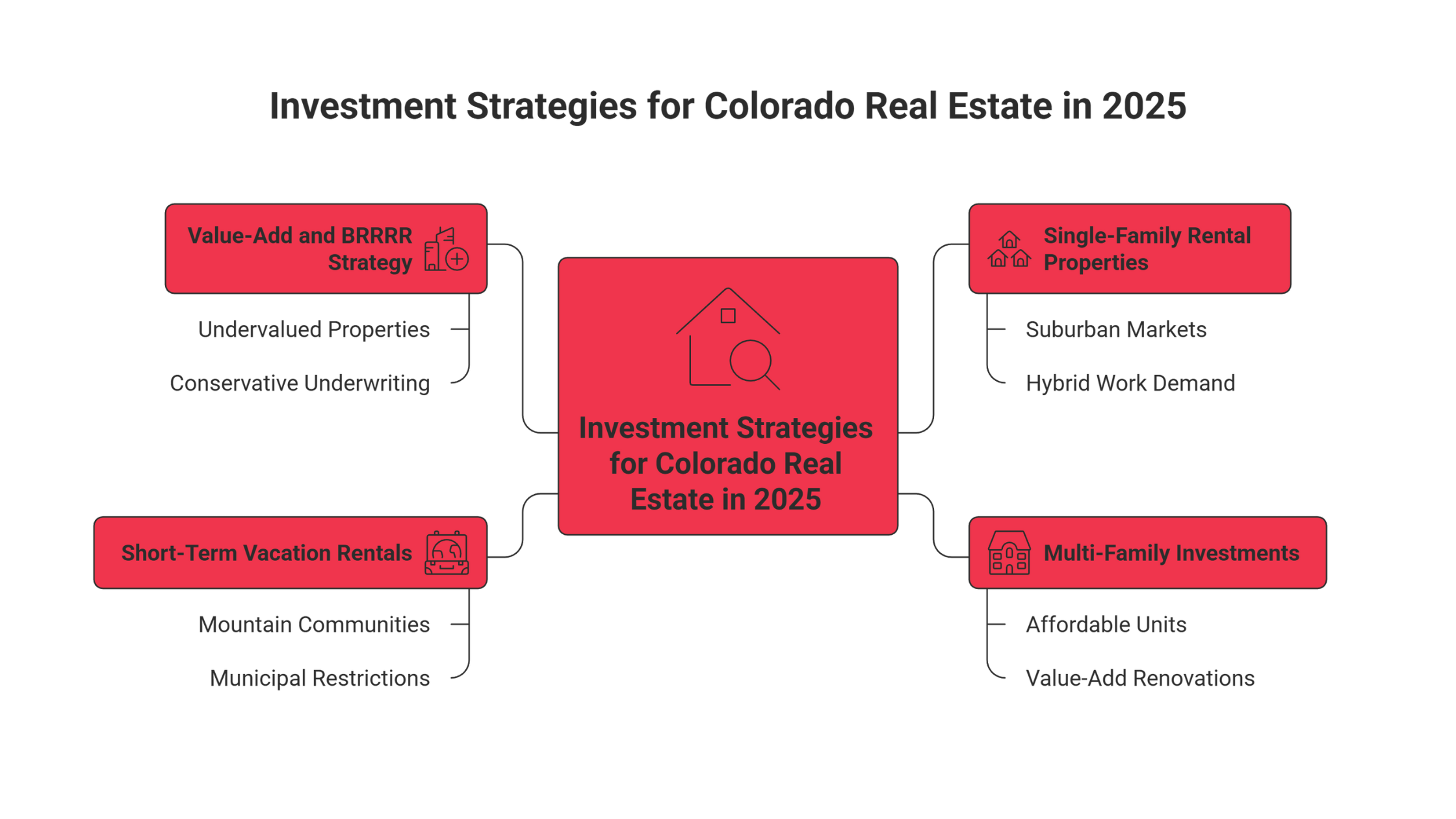
Investment Strategies for Colorado Real Estate in 2025
Single-Family Rental Properties
Single-family rentals remain the entry point for most investors. Suburban Colorado markets favor this property type, attracting families seeking schools, yards, and neighborhood stability. Recent market conditions, increased inventory and reduced competition improve negotiation positions for buyers.
The suburban shift driven by hybrid work supports single-family demand. Families prioritize space over walkability, and properties near quality schools command rent premiums while reducing turnover. Financing typically requires 20-30% down payments, with conventional mortgages offering competitive rates for qualified borrowers.
Multi-Family Investments
Multi-family properties provide diversification within a single asset. Vacancy in one unit doesn’t eliminate all income, and per-door acquisition costs often beat single-family alternatives. Colorado’s apartment demand stays robust, particularly for affordable B and C class units where renters priced out of homeownership concentrate.
New construction has slowed, reducing competitive supply and supporting rent stability. This favors investors willing to acquire older properties and implement value-add renovations. Financing requires different underwriting than single-family properties, with lenders focusing on property income and debt service coverage ratios.
Short-Term Vacation Rentals
Colorado’s tourism economy creates short-term rental opportunities, particularly in mountain communities. Revenue potential exceeds traditional rentals in the right locations, but management intensity and regulatory complexity increase proportionally.
Denver generates average annual revenue of $42,620-$47,000 per listing with59% occupancy rates. Gross yields average 7.5-8.0%, but net yields shrink after management fees and cleaning costs. Boulder averages $40,000-$45,000 annually, though stricter licensing caps limit profitability.
Colorado Springs shows61% occupancywith average revenue of $38,000 and7-8% gross yields. Mountain destinations like Vail and Breckenridge command $55,000-$75,000 per listing but face 48-53% occupancy. A sharp decline of 26,000 fewer mountain units in 2024-2025 as owners converted properties complicates projections. Municipal restrictions are tightening statewide.
Value-Add and BRRRR Strategy Opportunities
The BRRRR method—Buy, Rehab, Rent, Refinance, Repeat—gains traction in Colorado’s current environment. Identifying undervalued properties with renovation potential lets investors force appreciation through improvements. Cash-on-cash returns of 8-12% after refinance remain achievable in markets like Grand Junction when renovation budgets and ARVs are realistic.
Mike Hills, VP at Atlas Real Estate, scaled from single-family rentals to managing 6,000+ doors by focusing on value-add strategies. After losing money on a 2008 speculative project, he shifted to house hacking and buy-and-hold approaches. In the current market, he’s buying “entire developments at15-25% discounts to retail,” achieving instant equity. His approach emphasizes tenant retention and maintaining contractor relationships as labor availability improves.
The slowed appreciation and elevated mortgage rates require conservative underwriting. Investors applying BRRRR methods must ensure renovation costs don’t exceed forced equity gains and that post-refinance cash flow remains positive at current rates.
Key Considerations Before Investing in Colorado
Colorado-Specific Regulations and Landlord Laws
Colorado’s regulatory environment has tightened considerably. Starting January 1, 2026, landlords must return security deposits within30 daysof lease termination and may only withhold amounts for unpaid rent, utilities, lawful charges, and necessary repairs. Wrongful retention triggers liability for damages and potential legal action.
HB 1090 requires transparent rental pricing effective January 1, 2026. Landlords must provide tenants with a single, clear total price prominently displayed in rental offers, eliminating hidden fees. Violations are considered deceptive under consumer protection enforcement.
The Colorado Attorney General, counties, and municipalities now have explicit power to initiate legal proceedings for landlord-tenant law violations. Courts can appoint receivers for multifamily properties with ongoing health violations, transferring control from negligent owners to state-supervised management.
HB25-1004 prohibits rent price coordination between landlords or through third-party facilitators. Any collusion violates the Colorado State Antitrust Act, and tenants may file complaints if price-fixing is suspected.
Local rental licensing requirements vary by municipality. Denver and Boulder both require rental licensing, with Denver demanding licenses and safety inspections. Boulder mandates that leases starting after January 1, 2025 include a bolded statement about tenants’ rights to safe housing.
Insurance and Climate Risk Factors
Insurance costs are rising substantially across Colorado, driven by climate-related risks including wildfires, hail, and flooding. Theaverage annual premiumfor homeowner’s insurance in Colorado is approximately $1,850, notably above national averages.
Wildfire risk impacts both insurance eligibility and cost. Properties near fire-prone areas face higher premiums, stricter underwriting, and may require additional coverage. Some insurers limit new policies in the most vulnerable regions.
Colorado’s central and eastern regions experience some of the nation’s highest hail damage rates. Standard landlord insurance typically covers hail, but high claims frequency pushes up premiums and deductibles. Some policies impose separate, higher deductibles for wind or hail losses.
Flood insurance remains separate from standard policies and is often mandated in FEMA flood zones, averaging $700-$1,500 annually. Standard policies do not cover flood damage. One documented case near Colorado Springs illustrated these risks: an investor lost$200,000 in equityafter a wildfire destroyed an underinsured property.
Property Tax Implications Across Markets
Colorado offers relatively low property tax rates compared to coastal states, but recent changes have introduced complexity. For 2024-2025, most local governments use a6.25% residential assessment rate, while school district residential property is assessed at7.05%of actual value.
Non-residential properties are assessed at27% of actual value. For 2024, a $55,000 reduction in actual value applies for residential properties and a $30,000 reduction for commercial improvements.
Total property tax equals assessed value multiplied by the relevant mill levy, which varies between counties. Denver, Aurora, Colorado Springs, and Fort Collins each set different mill levies. Properties are reappraised biennially, with January 1 as the status date.

Financing Your Colorado Investment Property
Traditional Mortgage Options for Investors
Conventional financing remains the primary funding source for most Colorado investors. Current market conditions require careful analysis of borrowing costs. A Denver metro investor documented securing a conventional loan with a25% down paymentand locked a 6.75% fixed interest rate on a 30-year fixed mortgage, reflecting typical 2025 conditions.
Traditional mortgages offer stability through fixed rates and predictable payments, but qualifying requires strong credit, verifiable income, and substantial reserves. Lenders scrutinize investment property applications more stringently, with rates typically 0.5-0.75% higher and down payments starting at 20-25% for single-family rentals and climbing to 25-30% for multifamily properties.
Alternative Financing Strategies
Hard money loans provide speed for time-sensitive opportunities. A Colorado Springs fix-and-flip investor used hard money financing with 30% down and a one-year loan at 10% interest, enabling closing in 10 days. After stabilizing the property, they refinanced into conventional debt before sale.
DSCR loans assess rental income potential rather than personal income. A Fort Collins investor purchased a duplex using a DSCR loan with 20% down and approximately7.25% rateon a 30-year fixed product. After renovations, they refinanced to pull out equity.
Active Colorado DSCR lenders for 2025 include Select Home Loans (LTV up to 80%, $100k-$3M loans, minimum DSCR 1.0), Easy Street Capital (flexible credit guidelines, no strict DSCR minimum), CoreVest (fixed rates, 3-30 year terms, 75-80% LTV, minimum DSCR 1.0), Kiavi (tech-driven platform, minimum DSCR 1.1, LTV up to 75%), and Visio Lending (minimum DSCR 1.0, LTV up to 80%, $2M maximum).
Public-private financing structures exist for larger developments. Delwest received$6 million in loan financingthrough the Colorado Housing and Finance Authority, supplemented by $3 million in equity from the Proposition 123 Equity program for a 120-unit Commerce City project.
Down Payment and Reserve Requirements
Down payments for Colorado investment properties typically range from 20-30% of purchase price, depending on property type and financing structure. Lenders increasingly demand substantial cash reserves beyond down payments, typically 3-6 months of mortgage payments for each property in a portfolio.
Some investors use house hacking to reduce down payment requirements. Multiple first-time Colorado investors entered Denver, Boulder, and Fort Collins markets by purchasing duplexes or triplexes using FHA loans with as little as 3.5% down, living in one unit while renting others to offset mortgage payments.
How to Start Investing in Colorado Real Estate Today
Here’s how to start Colorado real estate investingwith confidence and measurable returns.
Step 1: Define Your Investment Goals and Budget
Successful investing starts with clarity. Determine whether you’re seeking monthly cash flow, long-term appreciation, or both. Budget considerations extend beyond purchase price, calculate total capital requirements including down payment, closing costs, immediate repairs, and reserves for vacancies and maintenance. Colorado’s elevated insurance costs and potential HOA fees affect monthly expenses. Run conservative projections assuming higher expenses and lower rents than optimistic scenarios suggest.
Step 2: Research and Select Your Target Market
Colorado investment opportunities vary dramatically by market. Denver offers diverse neighborhoods but commands premium prices. Aurora provides affordable entry points with solid appreciation. Colorado Springs combines military stability with tech growth. Fort Collins delivers university-anchored demand.
Study population trends, employment growth, wage levels, and construction pipelines. Markets where population and jobs grow faster than housing supply create upward pressure on rents and prices. Visit target neighborhoods in person—walking streets and observing conditions reveals ground truth about trajectories.
Step 3: Build Your Local Investment Team
Success depends heavily on your team. Start with a knowledgeable investment-focused real estate agent who understands rental markets, cap rates, and investor needs. Connect with experienced property managers early for market rent data, expense benchmarks, and neighborhood insights.
Establish relationships with reliable contractors before needing emergency repairs. Work with a mortgage broker familiar with investment property financing in Colorado. Consider connecting with local real estate investment associations like the Investment Community of the Rockies (ICOR), Colorado IA, or SoCo IA.
Step 4: Analyze Properties and Make Data-Driven Decisions
Successful properties are found through rigorous analysis, not hopeful assumptions. Calculate the 1% rule as a quick filter—monthly rent should equal at least 1% of purchase price. Run pro forma cash flow projections using conservative assumptions. Estimate vacancy at 8-10%, budget for property management at 8-10% of rents, and include maintenance reserves of $100-150 per door monthly.
Analyze comparable sales and rental data to verify assumptions. Inspect properties thoroughly—Colorado’s climate creates specific risks including foundation issues, roof damage from hail and snow, and HVAC stress from temperature extremes.
Step 5: Secure Financing and Close the Deal
Get pre-approved before making offers to demonstrate seriousness and enable faster closing. Submit complete loan applications promptly with all requested documentation. Schedule inspections immediately after offer acceptance and use findings to negotiate repairs or price reductions.
Review all closing documents carefully before signing. Verify loan terms match approval, title is clear, and all agreed repairs were completed. Once the deal closes, transfer utilities, implement insurance, and begin tenant placement or property management onboarding.

Common Mistakes Colorado Real Estate Investors Should Avoid
Underinsuring property against natural disasters represents one of the most catastrophic errors. The Colorado Springs investor who lost$200,000 in equityafter a wildfire destroyed an underinsured property learned this lesson permanently.
Overlooking restrictive HOAs or zoning codes before purchase destroys investment potential. Read HOA documents thoroughly and verify no restrictions prevent your intended use. Failing to identify structural and environmental risks creates expensive surprises, invest in thorough inspections and maintain contingencies.
Miscalculating returns or overpaying during market peaks destroys profitability. Run conservative projections and accept that if deals only work under best-case scenarios, you should find different properties. Over-leveraging with debt amplifies both gains and losses, maintain conservative loan-to-value ratios and adequate reserves.
Using short-term debt for long-term investments exposes you to refinancing risk. Match debt terms to hold periods. Underestimating cash flow and maintenance costs leads to negative surprises, budget conservatively and maintain emergency reserves. Being emotionally driven produces poor decisions, evaluate properties as financial instruments, not lifestyle statements.
Poor tenant vetting to fill vacancies quickly results in late payments, property damage, or costly evictions. Screen thoroughly for income verification, credit history, rental references, and criminal background. Lack of diversification across property types or locations exposes you to concentrated risk. Diversify across property types, locations, and price points.
Conclusion
Colorado real estate investing in 2025 rewards preparation, patience, and realistic expectations. The market has matured beyond speculative frenzy, creating conditions that favor investors who do their homework. Focus on fundamentals—positive cash flow, strong rental demand, reasonable leverage, and geographic diversification. Build a local team, understand regulations, plan for higher insurance and maintenance costs, and maintain conservative financial assumptions.
The state’s population growth, diverse economy, and lifestyle appeal remain intact. Properties purchased today at realistic prices with positive cash flow will likely deliver solid returns over time.
With decades of combined experience in Colorado’s Front Range markets, JROC Properties helps clients identify, renovate, and scale properties that perform. ContactJROC Propertiesto analyze your goals, secure financing insight, and find your next high-ROI investment opportunity.