
Aging in Place Remodeling: A Colorado Guide
Aging in Place Remodeling: A Colorado Homeowner’s Guide
Aging in place remodeling is the practice of updating a home so a person can stay in it safely and comfortably as they age, regardless of mobility, vision, or strength changes. According to AARP’s most recent Home and Community Preferences Survey, 75% of adults 50 and older want to remain in their current homes long-term, but more than half know their current home needs modifications to make that possible. The team at JROC Properties brings residential construction expertise to Colorado homeowners planning for the next thirty years, whether that means a $300 grab bar install or a full primary-suite addition.
This guide covers what aging in place remodeling actually includes, the core design principles, the highest-impact projects, realistic Colorado cost ranges, and the mistakes that turn a smart investment into a do-over.
Planning to stay in your Colorado home for the long haul?
JROC Properties helps Colorado homeowners scope aging in place remodels that protect independence and home value at the same time. → Book a planning call
TL;DR
Aging in place remodeling spans everything from $50 grab bars to $40,000 accessible bathrooms and $100,000 primary-suite additions. The highest-impact dollars usually go to the bathroom, where about a third of older-adult fall injuries happen. The cheapest projects (grab bars, lever handles, better lighting, non-slip flooring) deliver the largest safety return per dollar and should come first. The biggest projects (curbless walk-in shower, doorway widening, first-floor primary bedroom) make a home wheelchair-ready and add real resale value, with an accessible bathroom remodel returning roughly 49% at resale per the most recent national Cost vs Value data. Working with a contractor who holds a Certified Aging in Place Specialist (CAPS) credential is the single biggest predictor of a successful project.
Key Points
- Demand is real: 75% of adults 50+ want to age in place, but fewer than 4% of US single-family homes are easily modifiable for mobility challenges.
- Bathroom first: About 35.7% of adult fall injuries happen in the bathroom (CDC). Most aging in place projects start there.
- Typical cost range: $3,000 to $15,000 for targeted modifications. $20,000 to $40,000 for full accessible bathroom. $50,000+ for whole-home universal design.
- ROI: Accessible bathroom remodel returns about 49% at resale, and a more accessible home expands the future buyer pool.
- Where to start: Grab bars, lever handles, lighting upgrades, and non-slip flooring deliver the highest safety return per dollar.
- Hire CAPS: Certified Aging in Place Specialists (CAPS, through NAHB) understand the design rules, code requirements, and material choices that DIY contractors often miss.
- Plan for change: Build for the strength and mobility you may have in 15-20 years, not just the level you have today.
Table of Contents
What Is Aging in Place Remodeling?
Aging in place is the ability to live in your own home and community safely, independently, and comfortably as you age. Aging in place remodeling is the construction work that makes that possible: structural changes, fixture swaps, and design choices that remove barriers as strength, balance, vision, and grip change over time.
The scope is broader than most homeowners expect. At the low end, the work includes the kinds of upgrades that cost a few hundred dollars: grab bars in the bathroom, lever-handle door knobs, brighter bulbs, motion-sensor switches. At the high end, it covers structural work like widening doorways for wheelchairs, converting a main-floor office into a bedroom and bathroom suite, or building an elevator or stair lift. Most plans fall somewhere in between.
This kind of remodel is not the same as a standard renovation. A standard kitchen redesign optimizes for resale, aesthetics, and the homeowner’s current habits. An aging in place kitchen also accounts for someone who may eventually sit while cooking, struggle to bend into a low oven, or grip a slim faucet handle. The materials and the layout are different, even when the visual style stays current.
The biggest planning insight is that the work should happen before it is urgent. A homeowner in their late 50s who modifies the bathroom in a single project pays less, deals with less disruption, and gets to enjoy the changes for two decades. A homeowner who waits until after a fall or hospitalization is often paying premium rush rates, living in a half-finished house, and trying to coordinate construction around physical therapy.
Aging in place is also a category that benefits from working with a contractor who knows what they are doing. The National Association of Home Builders runs a Certified Aging in Place Specialist (CAPS) credential that trains contractors and designers in universal design, accessibility code, and product selection. NAHB’s CAPS designation page is the standard reference.
Aging in Place Remodeling: The Core Principles
Aging in place remodeling done well rests on four principles. Each one shows up in dozens of small design decisions, and missing any of them tends to produce a home that looks accessible but doesn’t actually feel that way to live in.
Universal Design Foundations
Universal design is the idea that a space should work for people across a wide range of ages, sizes, and abilities, without looking like a hospital. The classic seven principles, originally developed at North Carolina State University, are equitable use, flexibility, simple and intuitive use, perceptible information, tolerance for error, low physical effort, and adequate size and space for approach. Translated to a Colorado home, that means lever handles instead of knobs, large rocker light switches instead of small toggles, contrasting edges on countertops, and 36-inch-wide doorways throughout. The features cost about the same as conventional choices when planned upfront, and they make the home work better for everyone in the household, not just a future older self.
Safety First (Falls Prevention)
Falls are the single largest preventable health risk for older adults at home. The bathroom is the highest-risk room, accounting for about a third of all adult fall injuries. The kitchen and stairs come next. Effective safety design layers multiple defenses: non-slip flooring, grab bars at toilets and showers, walk-in or curbless showers with seats, comfort-height toilets, adequate lighting at every transition (especially night-lit paths from the bedroom to the bathroom), and removed tripping hazards like throw rugs and raised thresholds.
Accessibility and Mobility
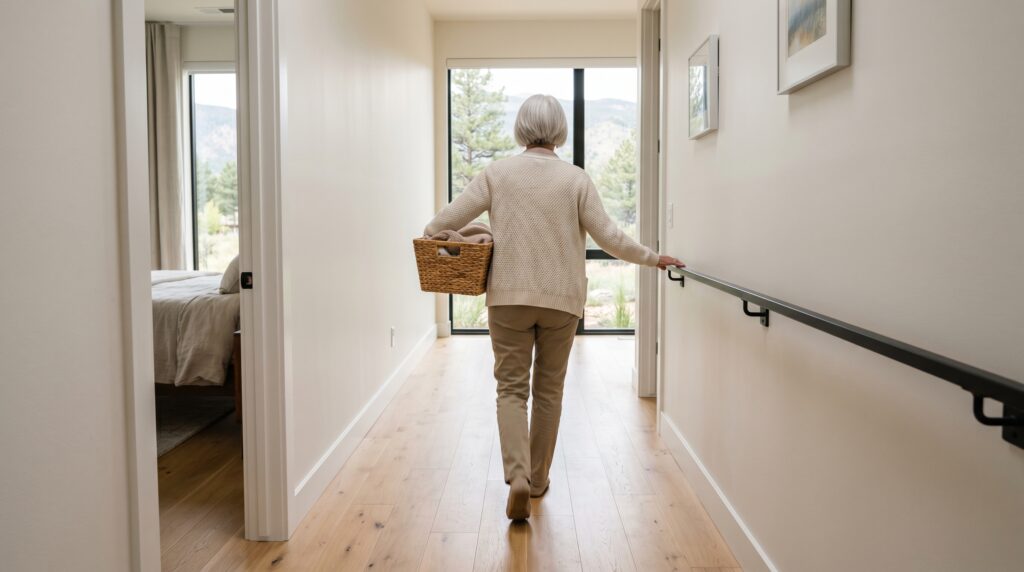
Accessibility means the home can accommodate a walker, wheelchair, or scooter if one is ever needed. Key dimensions matter: 36-inch-wide doorways, 42-inch-wide primary hallway, a 5-foot turning radius in the bathroom and at the front entry, a no-step entry from the driveway or garage. Most existing Colorado homes were built without these dimensions, which is why so few are easily modifiable. The good news is that some of these can be added later (doorway widening, entry ramps, threshold ramps), while others need to be planned into a structural remodel.
Future-Proofing for Health Changes
The fourth principle is the one most often skipped: building for the level of independence you may have in 15 to 20 years, not the one you have today. A 55-year-old who installs grab bars in the bathroom and a curbless shower today is investing in the version of themselves who, at 75, may have a hip replacement, glaucoma, or post-surgical mobility limits. The same is true for the kitchen, the bedroom, and the front entry. Quality home improvement ROI consulting models this trade-off explicitly, so the budget reflects probable future use rather than today’s snapshot.
Where Your Dollars Go Furthest
Highest-impact aging in place projects
Ranked by JROC priority score combining safety impact, accessibility return, and cost effectiveness. Smaller projects punch above their weight.
Don't skip the $300 grab bars while saving up for the $15,000 shower. The cheapest projects do the most for daily safety.
Sources: AARP 2024, CDC, Fixr, JROC build experience
The pattern across these four principles is consistent: the cheapest interventions deliver disproportionate returns on safety, and the most expensive ones tend to be the structural changes that make the home work for a walker or wheelchair if needed. A good aging in place plan layers the cheap wins first, then sequences the structural projects over several years.
The Highest-Impact Projects
Not all aging in place projects are created equal. The list below is sequenced the way a JROC remodel typically progresses, from highest-priority, lowest-cost interventions to bigger structural changes that should happen with a full remodel.
Bathroom Modifications
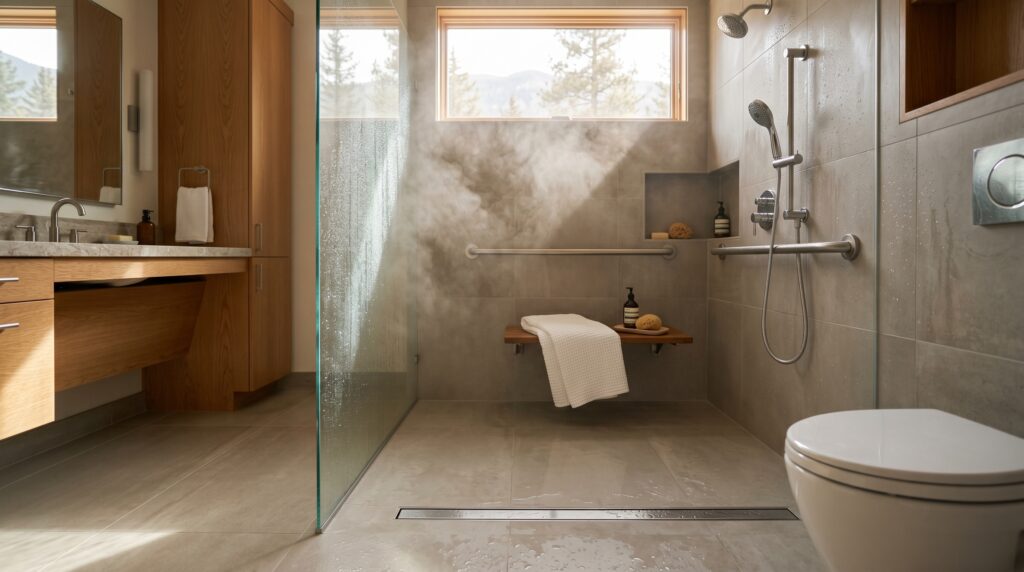
The bathroom is the most important room to address. Start with grab bars at the toilet and shower, non-slip flooring, and improved lighting. The next tier is a comfort-height toilet (about an inch taller than standard), a handheld showerhead, and a curbless or low-threshold walk-in shower with a fold-down seat. A full accessible bathroom remodel typically runs $20,000 to $40,000 in Colorado, depending on size and finishes. The CDC publishes excellent older-adult falls prevention resources that explain why the bathroom is the top priority. Our Colorado bathroom remodeling guide covers the full project scope and timeline.
Kitchen Adaptations
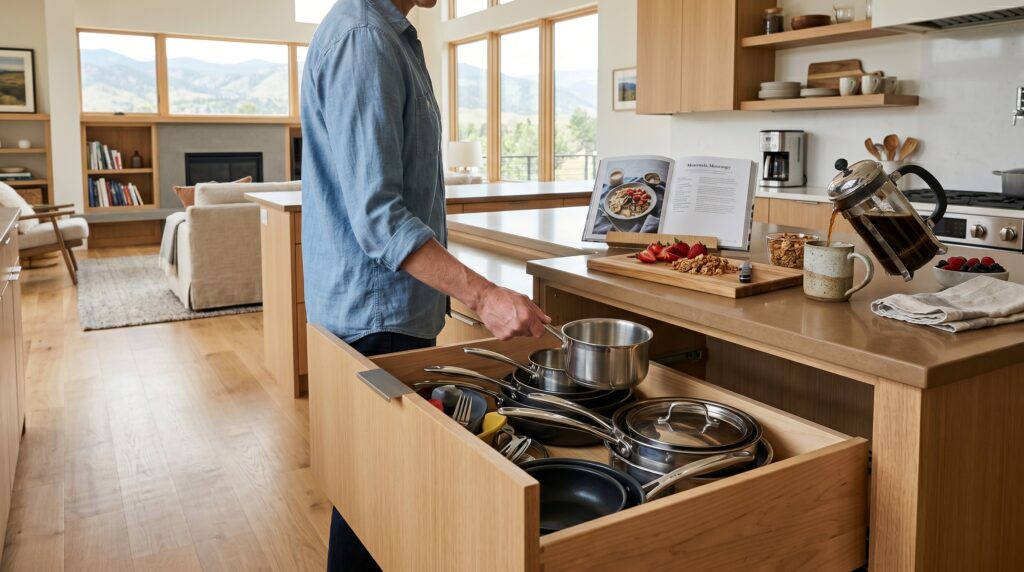
Kitchen accessibility focuses on reach, grip, and contrast. Replace deep base cabinets with full-extension pull-out drawers so items at the back are reachable without bending. Install lever-handle faucets and touchless models for users with arthritis. Add under-cabinet LED task lighting to reduce shadow on the work surface. Lower a section of countertop to 30 inches and leave knee clearance underneath so someone can prep food while seated. Add contrasting countertop edges so the boundary is visible. A targeted aging in place kitchen update runs $10,000 to $25,000 in Colorado, while a full accessible redesign reaches $50,000. See our Denver kitchen remodeling resource for a deeper walkthrough.
Entry, Doorways, and Floors
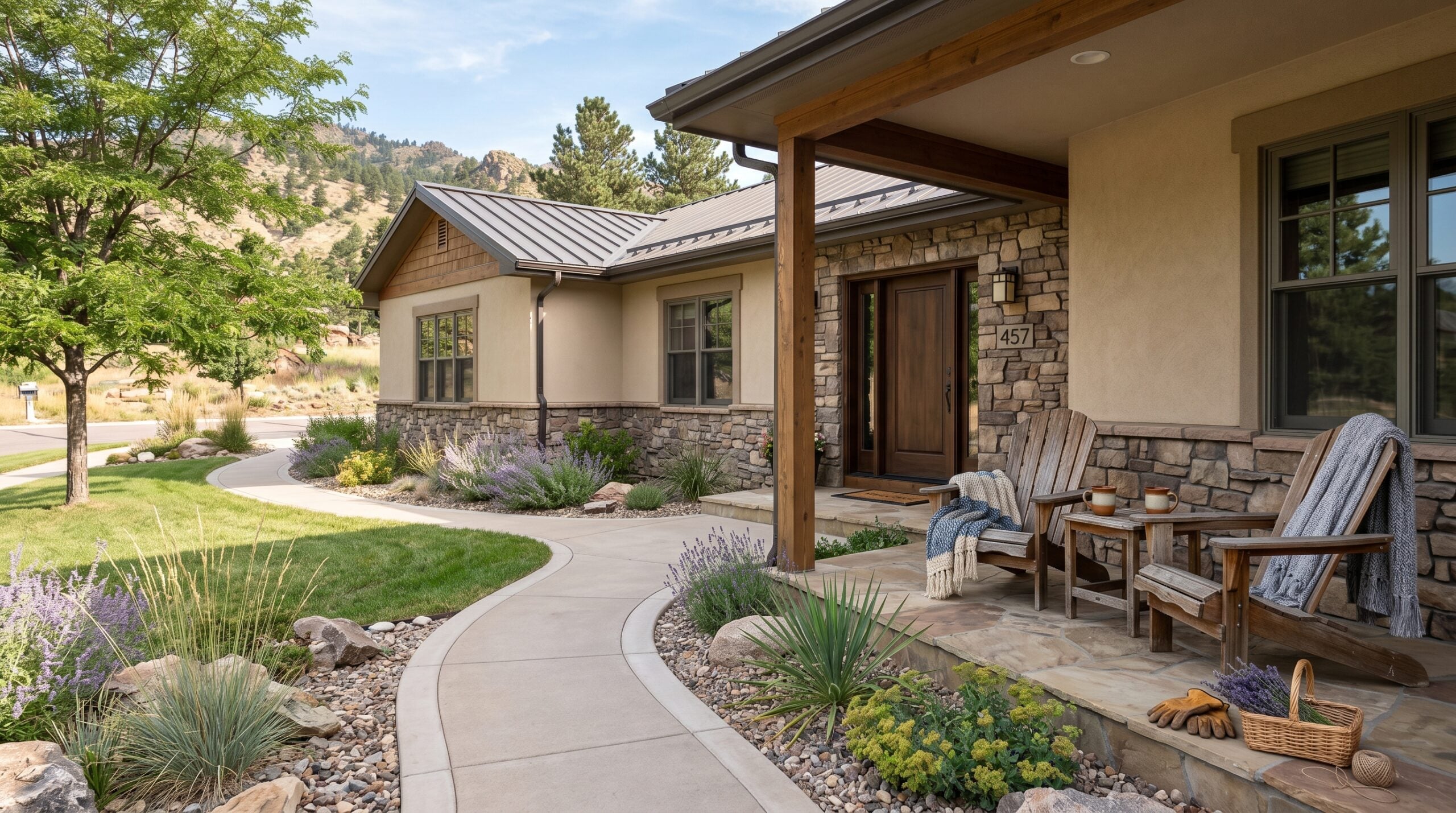
A no-step entry is the single most important structural change for long-term accessibility. Options include a gradual sloped walkway from the driveway, a covered porch with a low-rise threshold ramp, or in some cases a regraded front yard. Inside, widening primary doorways to 36 inches typically costs $300 to $2,500 each, depending on whether load-bearing studs are involved. Replacing high thresholds (the small raised lips between rooms) with flush transitions removes tripping hazards. Continuous hard-surface flooring eliminates rug edges and lets a walker or wheelchair roll smoothly.
Lighting, Switches, and Controls
Vision changes with age, and lighting is often the cheapest aging in place upgrade with the largest daily impact. Replace standard switches with large rocker switches or smart switches that can be voice-controlled. Add motion sensors on hallway and bathroom lights so middle-of-the-night trips don’t require fumbling for a switch. Upgrade fixtures to higher-lumen LED with warm color temperature (2,700K to 3,000K). Install dimmers everywhere so the home can be brightened for tasks and softened for evening.
Bedroom and Single-Floor Living
If the home is multi-story, planning for single-floor living is a long-term aging in place must. The cleanest approach is a first-floor primary suite, either by converting an existing main-floor room or by adding one. A conversion typically runs $5,000 to $25,000 depending on whether a bathroom is included. A new addition runs $80,000 to $150,000 or more in the Colorado market. For some homeowners, a smarter alternative is an accessory dwelling unit (ADU), which can house a caregiver, multi-generational family member, or even serve as the primary residence while the main house becomes rental income.
Aging in Place Costs in Colorado
Colorado costs run slightly above the national average due to labor rates, permit complexity in Front Range jurisdictions, and the prevalence of older homes with non-standard layouts. The ranges below reflect typical project scopes in Boulder County, Denver, Longmont, and Northern Colorado from real builds.
Demand for these projects is climbing fast. AARP’s 2024 Home and Community Preferences Survey found that 51% of adults 50 and older say they need a home that supports independent aging, and 72% specifically plan to add bathroom safety features. That demand pressure is showing up in Colorado contractor schedules: a routine bathroom accessibility remodel that booked in three months a few years ago now often books out four to six months in the Front Range, especially with CAPS-trained contractors.
| Project | Typical Cost | Priority | Disruption |
|---|---|---|---|
| Grab bars + non-slip mat (bathroom) | $300 – $1,500 | Essential | Half day |
| Lever handles + touchless faucets | $400 – $1,500 | Essential | 1 day |
| Lighting + dimmer upgrade | $500 – $2,000 | Essential | 1-2 days |
| Comfort-height toilet + bidet seat | $600 – $2,500 | Recommended | 1 day |
| Doorway widening (per doorway) | $300 – $2,500 | If staying | 2-4 days |
| Curbless walk-in shower | $4,000 – $15,000 | High value | 1-2 weeks |
| Full accessible bathroom remodel | $20,000 – $40,000 | Major | 3-5 weeks |
| First-floor primary suite addition | $80,000 – $150,000+ | Major | 3-5 months |
Some Colorado projects qualify for tax credits or grant assistance. The Colorado Division of Vocational Rehabilitation, certain Area Agencies on Aging, and several local nonprofits help fund accessibility work for qualifying homeowners. Eligible veterans may qualify for substantial home modifications through VA Specially Adapted Housing grants, which currently fund up to roughly $117,000 for SAH and $23,000 for SHA depending on the disability rating and adaptation type. Federal medical expense deductions can also apply to modifications prescribed for medical reasons. Worth investigating before writing the check.
Beyond grants, sequencing matters as much as the total budget. The most cost-efficient Colorado plans phase the work: essentials in year one (grab bars, lighting, lever handles, non-slip flooring) for under $5,000, then bigger structural projects (curbless shower, doorway widening) over the next two to three years as cash flow allows, and finally the largest moves (full bathroom remodel, first-floor primary suite) when they become genuinely useful. Trying to compress the whole list into one twelve-week build costs more, disrupts more, and leaves homeowners living in chaos. National ROI context for individual project categories lives in the most recent Cost vs Value Report from Remodeling magazine.
Want a clean budget on a Colorado aging in place remodel?
JROC Properties scopes aging in place projects with priority sequencing, real cost estimates, and CAPS-trained contractor referrals. → Get a planning estimate
Top 5 Aging in Place Mistakes to Avoid
These are the patterns JROC sees most often in Colorado homes where the work was done by a contractor without aging in place training.
- Treating it as one giant project. The best plans phase the work over several years, starting with the cheap-and-essential interventions. Trying to do everything at once usually blows the budget.
- Hiring a contractor without CAPS training. Aging in place has specific dimensional rules (36-inch doors, 5-foot turning radius, grab bar reinforcement) that standard remodelers often miss. Verify the credential before signing.
- Building for today’s mobility, not future mobility. If a hip replacement, vision loss, or stroke is even a possibility, the design should accommodate it. Building for the version of you who has the same body forever is a costly assumption.
- Choosing institutional-looking products. Grab bars, comfort-height toilets, and walk-in showers come in beautiful design-forward finishes now. There is no reason to settle for the hospital aesthetic. Browse JROC’s preferred vendors for product-level guidance.
- Skipping permits and inspections. Doorway widening, electrical changes for new lighting, and structural work for additions all require Colorado permits. Skipping them creates problems at resale and can void homeowner’s insurance after an injury.
Aging in Place FAQs
What is the most important aging in place modification?
Bathroom safety. About a third of older-adult fall injuries happen in the bathroom, and grab bars plus non-slip flooring are the cheapest interventions with the largest measurable impact. Start there, even if a full remodel is years away.
How much does an aging in place remodel typically cost?
Targeted modifications run $3,000 to $15,000 for most Colorado homes. A full accessible bathroom remodel runs $20,000 to $40,000. Whole-home universal design (including a first-floor primary suite addition) can exceed $150,000. The good news is that the highest-impact interventions are at the cheap end.
Will aging in place modifications hurt my home’s resale value?
Done well, they add value. The 2024 Cost vs Value Report showed an accessible bathroom remodel returning about 49% at resale, in line with other major bathroom remodels. Universal design features (lever handles, wide doorways, no-step entries) appeal to a much larger buyer pool than features designed only for older adults. Renovation strategy before selling in Colorado covers the resale angle in more depth.
Do I need a special contractor for an aging in place project?
Strongly recommended. The NAHB-administered Certified Aging in Place Specialist (CAPS) credential trains contractors and designers in universal design, accessibility code, and product selection. CAPS-trained pros are more likely to deliver work that holds up over decades of changing mobility, vision, and grip.
Is there financial assistance for aging in place remodels in Colorado?
Yes for some buyers. Veterans may qualify for VA Specially Adapted Housing grants. Some Colorado Area Agencies on Aging and certain nonprofits help fund modifications for low-income or disabled homeowners. Federal medical expense deductions can apply to modifications needed for medical reasons. Worth checking before paying out of pocket.
Conclusion
Aging in place remodeling is one of the highest-leverage construction investments a Colorado homeowner can make. The cheapest interventions (grab bars, lever handles, better lighting, non-slip flooring) deliver outsized safety returns and should happen now, regardless of age. The structural projects (curbless showers, doorway widening, first-floor primary suites) are worth phasing in before they are urgent, while construction costs and disruption are easier to absorb. A good plan starts with the bathroom, expands to the kitchen and entry, and builds toward single-floor living over five to ten years.
Founded by Jami and Rocco Montana, JROC Properties brings real estate expertise and residential construction knowledge together under one roof. Serving Boulder County, Denver, Longmont, and Northern Colorado, JROC helps homeowners sequence aging in place projects in the order that protects independence, safety, and home value at the same time. When you are ready to plan the next decade in your home, the JROC team is a call away.
Start your Colorado aging in place plan today.
Work with JROC Properties to scope, sequence, and budget an aging in place remodel that fits your home and your timeline. → Talk to JROC