
Colorado Property Tax Rates by County

Colorado Property Tax Rates by County
Colorado property tax rates by county vary more than most homeowners realize. The state has 64 counties, two separate residential assessment rates, and mill levies that can swing a tax bill by hundreds of dollars between two homes a few miles apart. Add in the 2024 legislation (SB24-233 and HB24B-1001) that reshaped the system starting in 2025, and the picture gets messy fast. The team at JROC Properties walks Colorado buyers through what their real annual tax bill is going to look like before they write an offer, not after closing.
This guide breaks down how Colorado property taxes actually work in 2026, the county-by-county effective rates worth knowing, and how to estimate your own bill before you fall in love with a home.
Want a real tax estimate before you buy?
The JROC Properties team can model the actual property tax bill on any Colorado home you’re considering, by county and tax district. → Book a quick call
TL;DR
Colorado has one of the lowest effective property tax rates in the country, with a statewide average around 0.49% compared to the national average near 0.90%. But within Colorado, county effective rates range from roughly 0.30% in rural southern counties to over 0.60% in parts of the metro area. Starting in 2025, residential property has two separate assessment rates: 6.8% for local governments and 7.05% for school districts, with the first $70,000 of value subtracted from the local government calculation. Your bill is then determined by your county’s mill levy, which varies by school district, fire district, water district, and any special metro districts. Two identical homes a mile apart can have annual tax bills hundreds of dollars apart.
Key Points
- Colorado statewide effective rate is roughly 0.49%, well below the US average of about 0.90%.
- Two assessment rates apply in 2026: 6.8% for local governments, 7.05% for school districts.
- County effective rates vary widely, from about 0.30% (Costilla, lowest) to 0.60% or higher (Adams).
- Mill levies are the variable that creates the biggest differences between similar homes in the same county.
- Notices of Valuation are mailed by May 1 each odd-numbered year. Appeals are due by June 1.
- Tax bills are paid in two halves (Feb 28 and June 15) or in full by April 30.
- JROC helps Colorado buyers estimate the real tax bill before writing an offer, not after closing.
Table of Contents
How Colorado Property Taxes Actually Work
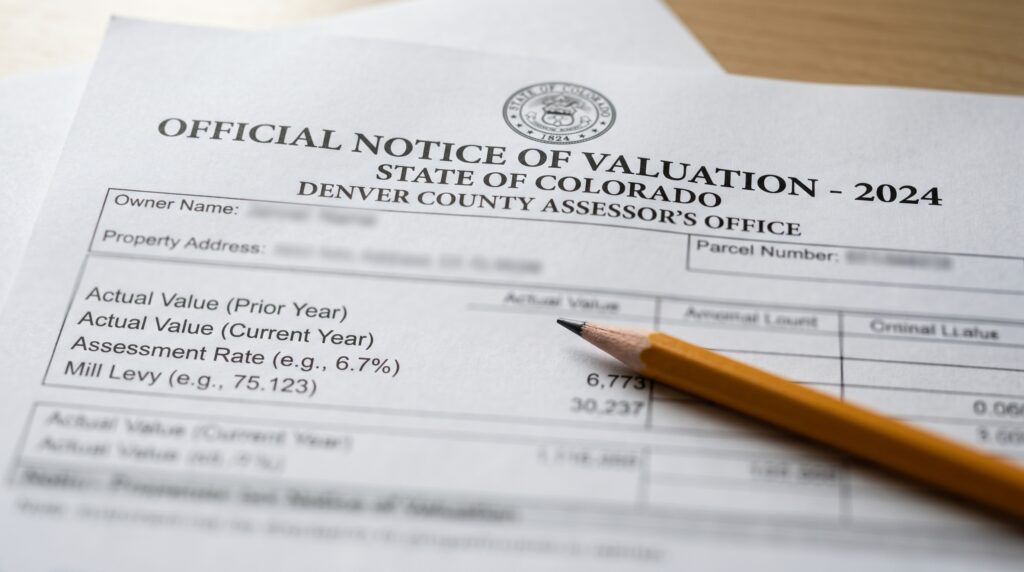
Colorado calculates property tax in three steps, and missing any of them is how buyers get blindsided at closing.
First, the county assessor determines the actual value of your home using comparable sales. For 2026 taxes, those sales come from January 2023 through June 2024. Second, that actual value is multiplied by an assessment rate to produce the assessed value. Starting in 2025, Colorado uses two separate rates: 7.05% for the school district portion and 6.8% for everything else (cities, counties, fire districts, water districts). The first $70,000 of value (or 10% of value, whichever is smaller) is subtracted before the local government rate is applied. Third, the assessed value is multiplied by your area’s mill levy to produce the annual tax bill. One mill equals $1 of tax per $1,000 of assessed value.
All of this is laid out in detail by the Colorado Department of Local Affairs Division of Property Taxation, which publishes the official assessment rates and explains the calculation step by step. The key practical takeaway: your county’s effective rate (annual tax divided by home value) bundles the assessment rate and the mill levy into one usable number for comparing properties.
Colorado Property Tax Rates by County
The single most useful number when comparing Colorado counties is the median effective property tax rate. That’s the actual annual tax bill divided by home value, averaged across the county. It bundles assessment rate, mill levy, and local exemptions into one comparable figure. Here’s the snapshot for the counties Colorado buyers ask about most.
Colorado Property Tax · 2026
Property tax rates by the numbers
Eight key data points on Colorado property tax rates by county for 2026, from the statewide average to the highest and lowest county bills in the state.
Statewide Avg
Colorado average effective rate
vs 0.90% USLocal Govt Rate
2026 residential assessment rate
After $70K cutSchools Rate
2026 school district assessment rate
Separate calcLowest County
Costilla County median annual bill
~0.30% rateBoulder Co
Effective rate, $3,800 median bill
Above CO avgLarimer Co
Effective rate, $3,050 median bill
Above CO avgDenver Co
Effective rate, $2,900 median bill
Below CO avgHighest County
Douglas County median annual bill
Top in stateMost of the bill-to-bill variation between Colorado counties comes from mill levies, not assessment rates.
Sources: CO Dept of Local Affairs, county assessors, SmartAsset
The counties JROC works in most often, with their typical effective rates and median annual bills, are summarized below.
| County | Effective Rate | Median Bill | vs CO Avg |
|---|---|---|---|
| Boulder County | ~0.55% | $3,800 | Higher |
| Larimer County | ~0.56% | $3,050 | Higher |
| Denver County | ~0.48% | $2,900 | Lower |
| Jefferson County | ~0.51% | $3,400 | Higher |
| Adams County | ~0.60% | $3,100 | Higher |
| Weld County | ~0.54% | $2,700 | Higher |
| Arapahoe County | ~0.52% | $3,050 | Higher |
| Douglas County | ~0.55% | $4,500 | Higher |
| El Paso County | ~0.43% | $1,900 | Lower |
The lowest effective rates are in rural southern Colorado: Costilla County’s median bill is about $317, with an effective rate near 0.30%. The highest median bills are in Douglas County (driven by high home values, not high rates) and the metro Front Range counties. For a county-level methodology example, see the Boulder County Assessor’s tax calculation page or the Larimer County Assessor’s office, both of which show exactly how the dual assessment rate gets applied in their jurisdictions.
Why Property Taxes Vary So Much Between Counties
Two homes, both worth $600,000, can have annual tax bills $1,000 apart depending on where they sit. Three forces drive that gap.
Mill Levy
Every taxing district (county, city, school district, fire district, library district, water district) sets its own mill levy each year based on its budget needs. Adding all of them together gives the total mill levy for a specific tax area, which often ranges from 60 to 120 mills across Colorado. The mill levy is the single biggest source of variation between similar homes.
Special and Metro Districts
Newer subdivisions in metro Denver, Adams County, and Douglas County often have metropolitan districts (special districts created to fund infrastructure like roads, water, and sewer in new developments). These can add 30 to 50 additional mills on top of the standard mill levy, and they don’t always show up clearly on listing pages. Always check whether a home sits inside a metro district before assuming the seller’s tax bill reflects what you’ll pay long term.
School District Lines
Because Colorado’s 7.05% schools assessment rate applies separately and school district mill levies differ, two homes on opposite sides of a school district line can have different tax bills even with everything else equal. This matters most along the boundaries between Cherry Creek, Douglas County, Boulder Valley, and Thompson school districts.
Buying near a metro district line?
The JROC team checks every home for metro district memberships and runs the real long-term tax math before you commit. → Get your tax estimate
How to Estimate Your Property Tax Bill in Colorado
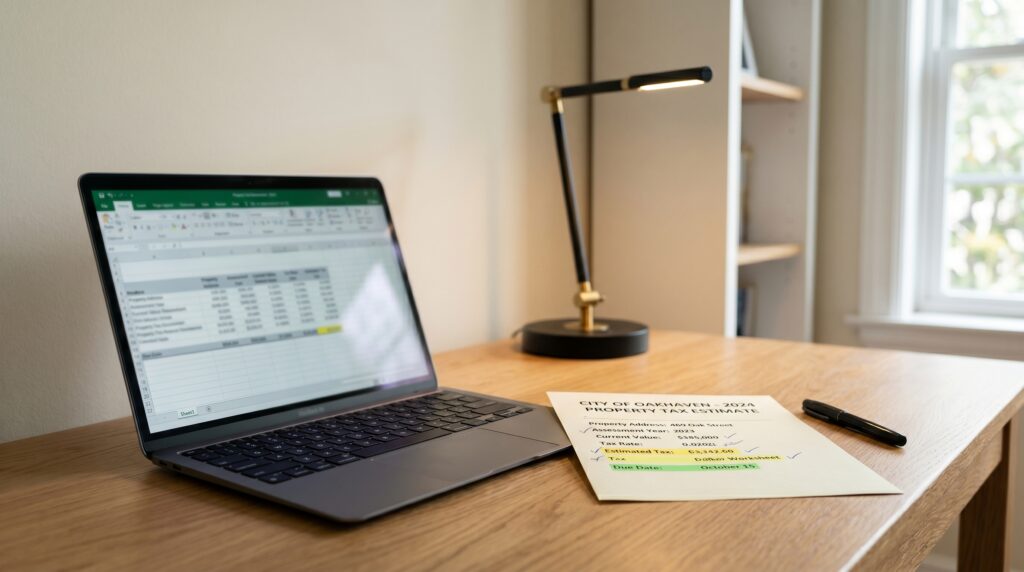
Before writing an offer on a Colorado home, it’s worth running the numbers yourself rather than trusting the seller’s previous tax bill. Three quick steps get you a realistic estimate.
- Pull the actual value from the county assessor. Every Colorado county publishes its assessor’s roll online for free. Search the property address and note the current actual value, last assessed value, and tax area code.
- Apply the 2026 assessment rates. Multiply actual value by 7.05% for the schools portion and by 6.8% for the local government portion (after the $70,000 reduction). That gives you two assessed values.
- Find your tax area’s total mill levy. County treasurer or assessor sites publish mill levies by tax area code. Multiply each assessed value by its respective mill levy (divided by 1,000), and add them together. That’s your annual tax. For more on the all-in cost picture, our guide to average closing costs in Colorado pairs nicely with the property tax math.
First-time buyers should pair this estimate with research on Colorado home loans and Colorado down payment assistance to see the full monthly payment picture, since lenders escrow taxes month by month.
Top 5 Things Colorado Homeowners Get Wrong About Property Taxes
These are the misunderstandings JROC sees most often when reviewing Colorado closings and tax bills.
- Assuming the seller’s tax bill is yours. Tax bills can change after a sale because exemptions don’t transfer and the new actual value gets reassessed in the next valuation cycle.
- Forgetting metro district mills. Newer-development homes can carry 30 to 50 additional mills that don’t show up in a basic county estimate.
- Missing the appeal window. Notices of Valuation arrive by May 1. Appeals are due by June 1. Miss it and you’re stuck for two years (since real property revalues every odd year).
- Confusing mill levy with effective rate. The mill levy is the rate per $1,000 of assessed value. The effective rate is annual tax divided by market value. Both are useful, but they’re different numbers. Our Colorado real estate market overview covers how all the moving parts fit together.
- Overlooking the senior exemption. Colorado homeowners 65+ who have lived in their primary residence for 10+ years can get 50% off the first $200,000 of actual value. The Colorado Department of Local Affairs senior exemption page walks through eligibility and how to apply. It can save $1,500 a year or more, but you have to file.
FAQs About Colorado Property Tax Rates by County
What is the average property tax rate in Colorado?
Colorado’s statewide effective property tax rate is around 0.49%, one of the lowest in the country compared to the US average of about 0.90%. But the effective rate varies by county, ranging from about 0.30% in rural southern Colorado to 0.60% or higher in parts of the Denver metro. The 2026 residential assessment rate is 6.8% for local governments and 7.05% for school districts, applied to the actual value before the mill levy gets calculated.
Which Colorado county has the highest property taxes?
By effective rate, Adams County tops the list at around 0.60%. By total median bill, Douglas County leads at around $4,500 per year because of higher home values. Pitkin County (Aspen) carries some of the highest absolute bills due to luxury home values, even though its effective rate is low. The SmartAsset Colorado property tax calculator has detailed county-by-county comparisons.
Which Colorado county has the lowest property taxes?
Costilla County in southern Colorado has the lowest median property tax bill in the state at about $317 per year, with an effective rate near 0.30%. Other low-tax counties include Prowers and Jackson, all in rural areas with low home values and minimal mill levies. These rates aren’t an option for most Front Range buyers, but they show the range across the state.
Did Colorado property taxes go up in 2026?
For most homeowners, yes. The temporary $55,000 residential value reduction from SB24-233 expired after 2024, and assessment rates increased slightly compared to 2024’s discounted rate. Even though some home values cooled, most homeowners saw their actual tax bills rise in 2026 because the temporary reductions phased out. Reporting from Colorado Public Radio covers the full timeline of the changes.
Conclusion
Colorado property tax rates by county vary more than the statewide averages suggest. While Colorado overall sits among the lowest-tax states in the country, the spread between Adams County and Costilla County is wide enough to materially change your monthly payment on the same priced home. Mill levies, school district lines, and metro districts are the variables that move the needle most. Run the numbers before you write the offer, not after closing.
Founded by Jami and Rocco Montana, JROC Properties brings real estate expertise and residential construction knowledge together under one roof. Serving Boulder County, Denver, Longmont, and Northern Colorado, JROC helps buyers and sellers understand the real all-in cost of any Colorado home, including the property tax bill they’ll actually pay. When you’re ready to get clear numbers on a specific property, the JROC team is a call away.
Get the real tax math on your next Colorado home.
Work with the JROC Properties team to model property tax, closing costs, and monthly payment on any Colorado home before you commit. → Start your home search