
Construction Payment Schedule Guide for Colorado Builders

Whether you are managing a kitchen remodel in Denver or building a new addition along the Front Range, a solid construction payment schedule keeps your project and your Colorado home equity on track. At JROC Properties, we have seen firsthand how the right payment structure protects homeowners from cost overruns, contractor disputes, and cash flow surprises. If you are planning a home improvement project in Colorado, understanding how to structure construction payments is one of the smartest moves you can make.
Below, we break down everything you need to know about construction payment schedules, including what to include, how different structures work, and how to avoid the most common mistakes that cost homeowners and contractors time and money.
Streamline Your Next Construction Project
Getting your construction payment schedule right from the start prevents costly disputes and keeps your build on budget. JROC Properties combines construction expertise with real estate insight to help you structure payments, vet contractors, and protect your investment.
TL;DR: Construction Payment Schedule
A construction payment schedule is a written agreement that ties payments to specific project milestones, protecting both homeowners and contractors from disputes and cash flow problems. The most common types include milestone-based, progress, time-based, and deposit-plus-final structures. Every schedule should include clear payment triggers, retainage terms, change order provisions, and documentation requirements. Retainage typically ranges from 5% to 10% of the contract price, withheld from each progress payment until substantial completion. Having a structured payment schedule in place before work begins saves time, reduces risk, and gives you real leverage if something goes wrong. Whether you are finishing a basement or adding square footage to your Colorado home, structuring payments correctly safeguards your investment and your home equity.
Key Points
- Payment schedules protect both parties: they set clear expectations for when and how much gets paid at each stage.
- Retainage (5%–10%): this percentage is typically withheld until project completion to incentivize quality work and defect resolution.
- Milestone-based schedules: these are the most popular structure for residential remodels in Colorado.
- Every schedule should include: contract details, payment amounts, triggers, due dates, retainage terms, and change order provisions.
- Use the sample breakdown below: as a reference to build your own schedule tailored to your project’s scope and budget.
- AIA billing standard: progress billing using the Schedule of Values (SOV) forms the backbone for G702/G703 forms, ensuring transparent payment applications.
- Need help planning your project? Contact JROC Properties for expert guidance on home improvements that build real value.
Table of Contents
What Is a Construction Payment Schedule and Why It Matters
A construction payment schedule is a contractual document that outlines when payments are due, how much is owed at each stage, and what conditions must be met before money changes hands. Think of it as a financial roadmap for your project, one that keeps everyone accountable.
Protects Cash Flow for All Parties
For homeowners, a payment schedule means you never pay for work that has not been completed. For contractors, it guarantees predictable income tied to real progress. This balance is especially important in Colorado’s competitive construction market, where labor expenses have risen roughly 4 to 5% year-over-year for many contractors. Construction job openings rose 42.4% annually to 292,000 through December, driving wage increases of 4.3% year-over-year amid ongoing labor shortages.
Reduces Payment Disputes and Legal Issues
Vague payment terms are the number one cause of construction disputes. A clear schedule, with defined milestones and documentation requirements, eliminates most of that friction before it starts.
Establishes Clear Project Expectations
When both sides agree to a construction payment schedule upfront, everyone knows what “done” looks like at each stage. That clarity keeps your project moving forward and protects the equity you are building in your Colorado home.
What Every Construction Payment Schedule Must Include
A payment schedule is only useful if it covers all the essentials. Here is what to include in yours.
Essential Contract Information and Project Details
Start with the basics: names and contact information for both parties, project address, scope of work, total contract value, and start and end dates.
Payment Breakdown and Amount Structure
List every payment installment with its dollar amount or percentage of the total contract. Be specific. “20% at framing completion” is far better than “payment upon progress.”
Payment Milestones or Triggers
Define what triggers each payment. Common milestones for residential projects include permit approval, foundation completion, framing, rough-in (electrical, plumbing, HVAC), drywall, and final inspection.
Due Dates and Payment Terms
Specify how many days a homeowner has to issue payment after a milestone is reached (typically 7 to 15 business days). Also note accepted payment methods and any late-payment terms.
Retainage Terms and Final Release Conditions
Retainage typically ranges from 5% to 10% of the contract price, withheld from each progress payment until the project reaches substantial completion. This incentivizes the contractor to address punch-list items and resolve defects before receiving the final payout. Retainage tracking integrates with AIA billing, requiring precise calculation of withheld amounts per period and cumulatively to avoid errors that lead to financial discrepancies at closeout.
Change Order and Additional Work Provisions
No project goes exactly as planned. Your schedule should spell out how change orders affect the payment timeline, who approves them, and how additional costs are documented.
If you are planning renovations to boost resale value, JROC Properties offers home improvement ROI consulting to help you prioritize the upgrades that matter most.
Types of Construction Payment Schedules (With Examples)
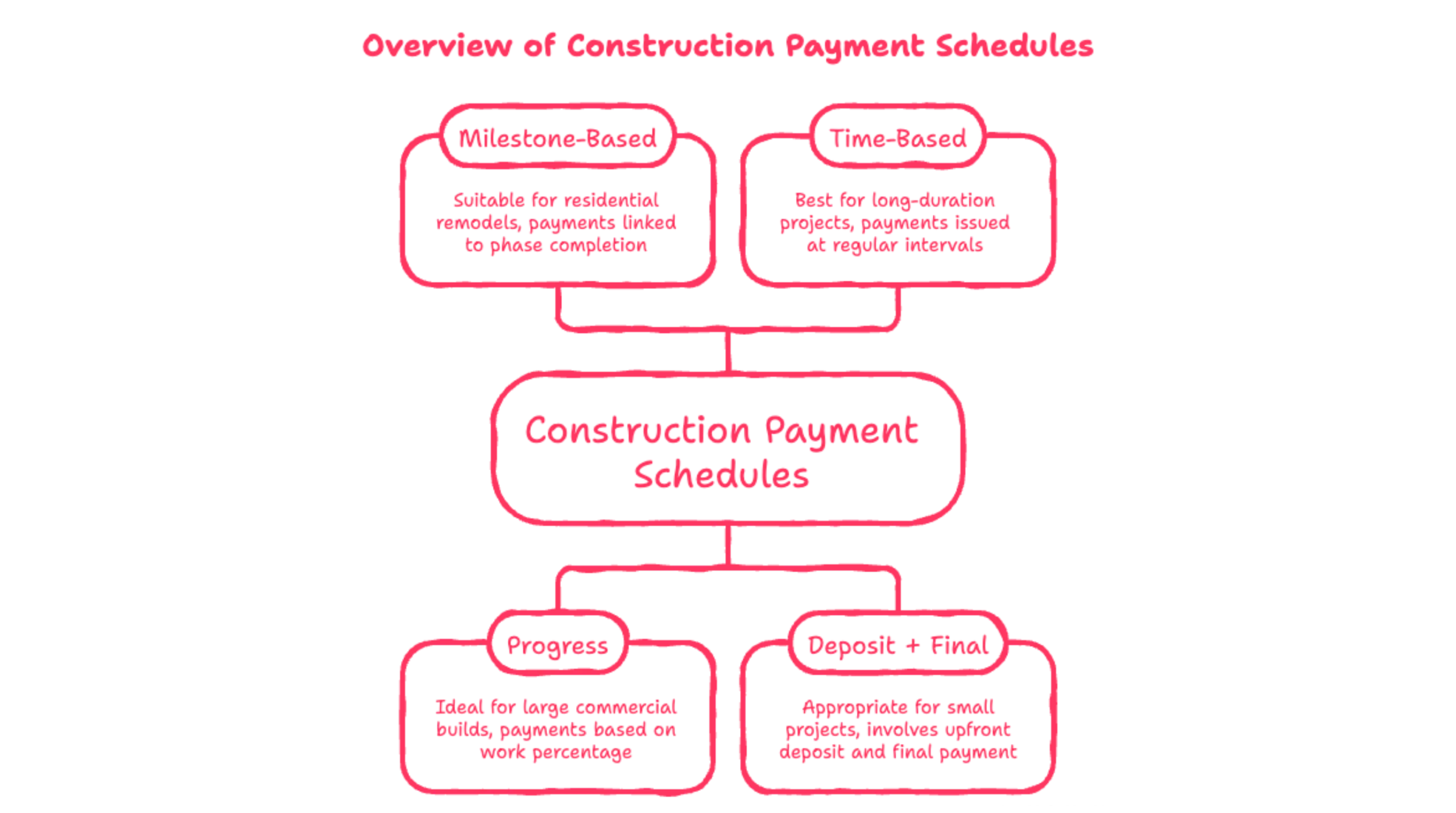
Not every project calls for the same approach. Here are the four most common payment schedule types and when each makes sense.
Schedule Type | Best For | How It Works |
Milestone-Based | Residential remodels, additions | Payments tied to completing defined project phases |
Progress | Large commercial or multi-phase builds | Payments based on percentage of total work completed |
Time-Based | Long-duration projects | Payments issued at regular intervals (monthly, biweekly) |
Deposit + Final | Small projects under $15K | Upfront deposit (25% to 50%) plus a final payment at completion |
Milestone-Based Payment Schedule
This is the most common structure for Colorado home renovations. Payments align with specific project phases: foundation, framing, mechanicals, finishes, and final walkthrough. It is straightforward and easy to verify.
Progress Payment Schedule
Progress billing is the industry standard for commercial construction payments, allowing contractors to bill for completed work incrementally. Contractors use a Schedule of Values (SOV) that details eligible items, values, and timelines. The SOV serves as the backbone for AIA billing, forming the foundation for G702/G703 forms where contractors detail work completed, materials stored, and cumulative totals. This method works well for large-scale projects but adds administrative complexity.
Time-Based Payment Schedule
Payments go out on a fixed calendar (e.g., the first of every month). This approach works for longer projects where milestones may be harder to define, but it offers less protection against slow progress.
Deposit and Final Payment Schedule
For smaller projects, think a bathroom remodel in Denver or minor repairs, a simple deposit-and-final structure keeps things easy. The homeowner pays 25% to 50% upfront, with the balance due at completion.
Retainage and How It Affects Your Schedule
Retainage typically ranges from 5% to 10% of the contract price. Owners withhold this amount from each progress payment until substantial or full project completion. This creates a financial incentive for the contractor to deliver satisfactory work and resolve defects. Your schedule should clearly state the retainage percentage, when it applies, and the specific conditions for its release.
How to Build a Construction Payment Schedule for Your Project
A standard structure gives you a starting point, but every project is different. Follow these five steps to build a payment schedule that fits yours.
Step 1: Choose the Right Payment Structure Type
Match the schedule type to your project’s size and complexity. Milestone-based works for most residential work. Progress billing suits commercial or phased builds.
Step 2: Define Clear, Measurable Payment Triggers
Each trigger should be verifiable, tied to an inspection, a photo, or a sign-off. Avoid subjective language like “substantially complete.”
Step 3: Set Realistic Payment Amounts and Percentages
Align payment percentages with the actual cost of work at each stage. Do not let any single milestone exceed 25% to 30% of the total contract value.
Step 4: Establish Documentation Requirements
Require invoices, lien waivers, inspection reports, and progress photos before each payment. Real-time SOV software updates from job sites enable immediate progress billing accuracy, linking to Work Breakdown Structure (WBS) for granular cash flow forecasting. This protects your Colorado home equity and creates a clear paper trail.
Step 5: Include Contingencies for Changes and Delays
Build in language for how change orders, weather delays, and material substitutions will be handled financially. A 5% to 10% contingency line item is standard practice. For more on managing construction contingencies and budgets, check out our construction contingency guide.
Sample Construction Payment Schedule Breakdown
Here is a sample milestone-based payment schedule for a typical Colorado kitchen remodel valued at $50,000.
Milestone | % of Contract | Amount | Trigger |
Contract Signing / Deposit | 10% | $5,000 | Signed contract and permits filed |
Demolition Complete | 15% | $7,500 | Demo finished, site cleared |
Rough-In (Plumbing, Electrical, HVAC) | 20% | $10,000 | Rough inspections passed |
Cabinets and Countertops Installed | 25% | $12,500 | Cabinets set, counters templated and installed |
Finishes and Fixtures | 20% | $10,000 | Tile, paint, fixtures complete |
Final Walkthrough and Punch List | 10% | $5,000 | All punch items resolved, final inspection passed |
Note: The retainage in this example is built into the final milestone payment. On larger projects, retainage (5% to 10%) may be withheld separately from each draw.

Common Payment Schedule Problems and How to Avoid Them
Even with a solid payment schedule, things can go sideways. Here are the most common pitfalls and how to sidestep them.
Vague Milestone Definitions Leading to Disputes
“Rough-in complete” means different things to different people. Define every milestone in measurable terms: “All rough plumbing, electrical, and HVAC installed and passed city inspection.” The more specific, the better.
Inadequate Documentation and Proof of Completion
Without photos, signed inspection reports, and lien waivers, disagreements become he-said-she-said situations. Require documentation before every payment release.
Cash Flow Gaps Between Payment Periods
Front-loading too much payment early in a project leaves you with little leverage later. Spread payments proportionally to the actual value of work at each stage. Data center construction spending alone is estimated at $65 to $70 billion and growing potentially to $80 billion, fueling demand for efficient payment schedules on mega-projects booked into 2027.
Retainage Withholding and Release Issues
Retainage disputes are among the most common in construction. Clearly outline the conditions for retainage release, including timelines, required documentation, and who signs off.
Managing Change Orders Without Derailing the Schedule
Change orders should be documented with their own mini-schedule: what changed, how much it costs, how it shifts the timeline, and when payment is due. Never approve verbal change orders. Always get it in writing.
Top 5 Best Practices for Managing Construction Payment Schedules
Managing a payment schedule is not just about having one. It is about using it well. These five practices help Colorado homeowners and contractors stay in control.
- Document everything and maintain detailed records. Keep photos, receipts, and signed inspection reports for every milestone. Good records prevent disputes and protect your investment.
- Communicate payment status proactively. Do not wait for a contractor to chase you. Acknowledge milestone completion and confirm payment timelines promptly.
- Review and adjust as project conditions change. Weather delays, material shortages, and design changes are normal. Update the schedule in writing whenever the scope shifts.
- Use conditional payment clauses strategically. Tie payments to verified inspections or third-party sign-offs for added protection on larger projects.
- Include retainage release criteria. Specify exactly what must happen (final inspection, punch list completion, lien waivers) before you release withheld funds.
If you are considering a bigger project like a basement finish or home addition, these practices become even more critical. JROC Properties can connect you with preferred vendors who follow industry-standard payment processes.
Planning a Colorado Renovation or Build?
JROC Properties provides home improvement ROI consulting to help you plan budgets, set realistic contingencies, and protect your investment throughout the project. Explore our home improvement ROI consulting →

When to Consider Software Solutions for Complex Projects
A well-structured payment schedule works well for straightforward projects: a single remodel, a small addition, or a cosmetic refresh. But if you are managing multiple phases, coordinating several subcontractors, or working on a commercial build, dedicated construction payment software (like Procore or Buildbook) can automate billing, track retainage, and integrate with your accounting systems.
Real-time SOV software updates from job sites enable immediate progress billing accuracy, linking to Work Breakdown Structure (WBS) for granular cash flow forecasting. For most Colorado homeowners, though, a well-structured payment schedule paired with clear communication is more than enough.
Construction Payment Schedule FAQs
What is a payment schedule?
A payment schedule is a documented plan that specifies when and how much money is due at each stage of a construction project. It ties payments to milestones, timelines, or progress percentages so both parties have clear expectations.
What is a typical construction payment schedule for residential remodels?
Most residential remodels in Colorado use a milestone-based structure: 10% at contract signing, then incremental payments at demolition, rough-in, installation, finishes, and final walkthrough. The exact percentages depend on project scope and complexity.
How much retainage should I expect?
Retainage typically ranges from 5% to 10% of the contract price. Owners withhold this amount from each progress payment until the project reaches substantial or full completion. This incentivizes quality work and timely defect resolution.
Do I need software for a large commercial project?
A basic payment schedule structure works well as a starting point, but large commercial projects with multiple subcontractors and long timelines usually benefit from dedicated construction payment software that automates tracking, retainage calculations, and AIA billing compliance.
What happens if work falls behind schedule?
A well-written payment schedule protects you. If milestones are not met, payments do not release. Your schedule should also include provisions for how delays affect the timeline and any associated cost adjustments.
Conclusion
A strong construction payment schedule does more than organize your finances. It protects your investment, reduces conflict, and keeps your project moving. Whether you are tackling a renovation before selling or making improvements to build long-term Colorado home equity, getting the payment structure right from the start makes all the difference.
Founded by Jami and Rocco Montana, JROC Properties brings together residential construction expertise and real estate knowledge under one roof. Serving Boulder County, Denver, Longmont, and Northern Colorado, our team helps homeowners and investors navigate construction budgeting with the transparency, communication, and discipline that keeps projects on track. Whether you are planning a home improvement project or evaluating a real estate investment in Denver, JROC’s hands-on approach ensures your payment planning reflects reality, not wishful thinking.
Ready to Plan Your Next Construction Project?
JROC Properties provides construction expertise and real estate guidance throughout Boulder County, Denver, and Northern Colorado. Let us help you plan a project that stays on budget and protects your investment. Get started with JROC Properties →