

Home Inspection Red Flags That Can Kill a Deal
Home inspection red flags can make or break your Colorado home purchase. The inspection phase protects you from hidden structural damage, outdated electrical systems, and environmental hazards that could cost tens of thousands to repair. With about 50% of Colorado homes testing above EPA action levels for radon and Front Range properties facing unique moisture challenges from snowmelt and freeze-thaw cycles, understanding what qualifies as a serious defect versus routine maintenance is essential. At JROC Properties, we guide buyers through inspection findings every day, helping you distinguish between deal-breakers and negotiable repairs in Colorado’s competitive 2026 market.
TL;DR
This guide walks Colorado home buyers through the most critical red flags inspectors find in 2026, from foundation cracks and outdated wiring to mold, HVAC failures, and environmental hazards. You’ll learn which issues warrant walking away versus negotiating repairs or price reductions, typical repair costs for major systems, and when to bring in specialist evaluations beyond the general inspection. Understanding home inspection red flags helps you make confident decisions, protect your investment, and avoid properties with hidden problems that could cost $15,000 to $30,000 or more in structural repairs alone.
Key Points
- Structural red flags like significant foundation cracks, bowing walls, or compromised framing typically require licensed engineer evaluation and can cost $15,000–$30,000+ for major repairs
- Electrical hazards including aluminum wiring, Federal Pacific panels, and unpermitted DIY work create fire and safety risks; panel upgrades run $800–$4,000 and full rewiring starts around $5,000
- Plumbing red flags such as polybutylene pipes and sewer line failures can require $3,000–$10,000+ for replacements
- Colorado-specific concerns include radon in approximately 50% of homes, expansive clay soil foundation movement, and altitude-related HVAC sizing issues
- Use inspection findings strategically: inspection reports commonly identify $5,000–$15,000 in needed repairs that strengthen negotiating position
- Walk away when: safety/structural issues exceed your budget, seller won’t negotiate documented problems, or total repair scope fundamentally changes the property’s value
Table of Contents

What Qualifies as a Home Inspection Red Flag in 2026
A home inspection red flag is a condition that significantly affects safety, structural integrity, or habitability. These aren’t minor cosmetic issues like worn paint or small drywall dings. Authoritative inspection standards define material defects as conditions that “significantly affect the value, habitability or safety of the dwelling,” requiring clear documentation in the inspection report.
The distinction matters because it shapes your entire negotiation strategy and budget. When you’re buying a home in Colorado, especially in markets like Denver, Boulder, or Longmont, understanding which findings truly threaten your investment helps you focus on issues that protect your long-term financial security and family’s safety.
Red Flags vs. Minor Issues: Understanding the Difference
Material defects demand immediate attention or professional correction, while minor issues represent normal wear you can address through routine maintenance. Across professional standards, the line is drawn by whether a condition creates current or imminent danger, significantly affects home systems, or will cause escalating damage if ignored.
Critical red flags include unsafe electrical conditions, active roof or plumbing leaks causing damage, structural movement threatening wall stability, and health hazards like mold or carbon monoxide risks. These conditions affect livability and code compliance, often triggering lender or insurance requirements before closing.
Minor issues like cosmetic wear, older but functional fixtures, or routine maintenance needs fall outside the scope of urgent defect reporting. Hairline drywall cracks, typical roof aging without active leakage, and worn finishes are noted for planning purposes but don’t represent immediate threats to safety or structural soundness.
Critical Structural Red Flags That Signal Major Problems
Structural issues represent the most expensive and potentially dangerous findings during home inspections. Foundation problems are identified as the biggest deal-breakers in home purchases nationally, with roof failures and compromised framing following closely behind.
When JROC Properties reviews inspection reports with buyers, we immediately flag conditions that indicate active or advanced structural distress. These issues typically need licensed structural engineer evaluation before you commit to a purchase, especially in Colorado where deep frost depths, expansive clay soils, and pronounced freeze-thaw cycles create unique foundation challenges.
Foundation Cracks, Settlement, and Structural Movement
Horizontal cracks, stair-step cracks in masonry, or any crack wider than about 1/4 inch signal potential structural movement that requires professional assessment. These patterns strongly suggest differential settlement or lateral soil pressure that can jeopardize wall stability and load paths.
Foundation issues become deal-breakers when you see noticeable sloping floors, doors and windows that stick or won’t latch, and gaps between walls, floors, or ceilings. These field signs indicate different parts of the foundation are moving at different rates, often requiring underpinning, soil remediation, or partial reconstruction.
Bowing or leaning basement walls, especially with long horizontal cracks near mid-height, usually indicate excess lateral earth or hydrostatic pressure with real risk of partial wall failure. Colorado’s rapid snowmelt over frozen Front Range soils creates extreme short-term hydrostatic pressure at foundations. Inspectors report that late-winter/early-spring melt events saturate soil while it’s still partially frozen, so meltwater ponds against foundations and drives water through cracks.
The Front Range corridor has widespread expansive clays and bentonite along I-25, creating one of Colorado’s most costly geologic hazards. Denver-area inspection firms frequently see stair-step cracks in foundation walls, heaving basement slabs, and doors out of square in post-1990 tract homes in areas like Thornton, Brighton, Erie, and Windsor. This isn’t occasional (it’s a recurring structural concern that shows up across multiple Denver-metro subdivisions).
Repair costs reflect the severity. Foundation crack sealing runs $300–$800 per crack, but major structural repairs with piers and underpinning commonly hit $15,000–$30,000+. National data shows typical residential foundation repair projects averaging around $2,200–$8,100, with severe problems frequently cited at $20,000 or more.
Roof Damage and End-of-Life Warning Signs
Major roof defects rank as one of the most expensive common post-inspection discoveries, frequently running $10,000–$20,000+ depending on size and materials. Active roof leaks, widespread deterioration, or signs the roof is nearing the end of its expected lifespan are high-priority red flags. Inspectors look for missing or curled shingles, water stains on ceilings and attic framing, sagging areas, and improper flashing around chimneys and vents.
Colorado’s Front Range falls in one of the most hail-prone corridors in the U.S., and Denver-area inspection firms consistently list roof damage and leaks as one of the top deal-breaking issues they find. Composite shingle roofs at 5,000–6,000 feet experience faster aging from UV exposure; Denver inspectors often flag shingles as near end of useful life around 15–20 years even when a product might be marketed for 30 years at lower elevations.
When inspection reports note roof concerns, get specific contractor bids rather than relying on rough estimates. Roof repair averages about $1,150 nationally, with most jobs ranging $400–$1,900 for minor fixes. Major repairs including sagging reinforcement or structural damage commonly run $3,000–$8,000+, while a complete roof replacement often starts around $12,000 for typical homes.
Temperature swings cause meltwater in cracks and at the base of walls to repeatedly freeze and expand, widening existing defects and defeating older waterproofing coatings that then leak under peak snowmelt pressure. Common 2024–26 inspection red flags include hail-bruised or fractured shingles with granule loss and exposed mat, improper or missing flashing especially around chimneys, deteriorated wood or fiber-cement siding, and poor grading with water pooling at the foundation.
Compromised Framing and Load-Bearing Issues
Visible sagging, gaps in walls, misaligned doors or windows, and out-of-square openings can indicate compromised framing or load-bearing elements. These issues may arise from poor construction, unauthorized structural modifications, or damage over time from moisture, pests, or settlement.
Prior structural repairs without clear engineering documentation also raise red flags. Existing piers, sistered beams, jack posts, or patched foundation sections may have treated symptoms rather than causes, and undocumented repairs can hide ongoing movement that complicates future remediation.
Addressing framing problems often involves extensive renovations, including opening walls, reinforcing or replacing structural members, and bringing work into code compliance. JROC Properties emphasizes that extensive structural repairs are a resale red flag in our renovation planning guidance, positioning early identification and correction of these issues as key to maximizing ROI and preventing deal-killing inspection surprises.
Electrical System Red Flags and Safety Hazards
Hazardous or obsolete electrical systems are explicit deal-breakers in Colorado broker guidance rather than negotiable items. Outdated wiring, insufficient panel capacity, and DIY electrical work create immediate fire and shock risks that insurers and lenders scrutinize heavily.
Outdated or Dangerous Wiring (Aluminum, Knob-and-Tube)
CPSC investigations found that older solid aluminum branch-circuit wiring has a much higher rate of overheating and fire at connections than copper, due to cold-flow, oxidation, and incompatibility with many devices. CPSC safety recommendations emphasize identification of aluminum branch circuits and use of approved repair methods rather than simple device replacement, which doesn’t reliably reduce fire risk.
Knob-and-tube wiring gets flagged as a major concern when buried in insulation, mechanically damaged, or modified. The original open-air installation assumptions no longer hold, which can cause overheating and fire. Modern guidance stresses that knob-and-tube lacks equipment grounding, is often undersized for today’s loads, and is prone to unsafe amateur splices.
Aluminum wiring remediation typically costs $200–$400 per affected circuit, implying several thousand dollars total in homes with many aluminum-wired branch circuits. A 2025 case study overview notes that homes with aluminum wiring and multiple fire hazards often require complete rewiring at costs around $15,000–$20,000, and insurers may refuse coverage until systems are brought to code.
Panel Issues: Insufficient Capacity and Federal Pacific Panels
CPSC testing documented that many Federal Pacific Electric “Stab-Lok” breakers failed to trip under overload or short-circuit conditions at rates far exceeding standards, creating serious fire and shock hazards. Safety bulletins characterize these panels as inherently unreliable overcurrent protection and recommend full panel replacement, not just swapping individual breakers.
Undersized services, overloaded panels, and circuits protected by over-sized fuses or breakers defeat overcurrent protection, allowing conductors and terminations to overheat and ignite. NFPA and CPSC materials stress that adequate service and properly sized breakers are essential for fire safety.
Main panel replacement or upgrade to 100–200A typically runs $800–$4,000 for most homes, with base panel swaps commonly $800–$2,000 and 200-amp upgrades around $1,800–$4,500. High-capacity 400A service upgrades can reach $4,000–$12,000.
DIY Electrical Work and Code Violations
Home inspectors consistently flag missing GFCI receptacles in wet locations, missing AFCI protection in habitable rooms, and three-prong receptacles added to older 2-wire circuits without real ground or GFCI protection. Open splices outside junction boxes, wire nuts hanging in attics, and cables simply stapled along walls are among the most frequently cited violations and obvious DIY fire hazards.
Double-tapped breakers, undersized conductors on larger breakers, and obviously overloaded circuits are core red flags in inspector training. Additional branch circuits tied into existing breakers instead of adding new ones, mixed wire gauges on the same circuit, and continued use of recalled or problematic panels are common DIY errors.
Unpermitted or poorly executed DIY work can lead to denied insurance claims if a fire is traced to non-code work. Partial or full house rewiring typically starts around $5,000 and rises with house size and circuit count.
Plumbing Red Flags That Lead to Costly Repairs
Major plumbing and sewer line failures are identified as major deal-breakers in Colorado inspection content, especially in older Denver/Boulder neighborhoods with clay or cast-iron sewer laterals. Outdated pipe materials, sewer line problems, and water pressure inconsistencies often signal expensive repairs ahead.
Polybutylene and Galvanized Pipe Problems
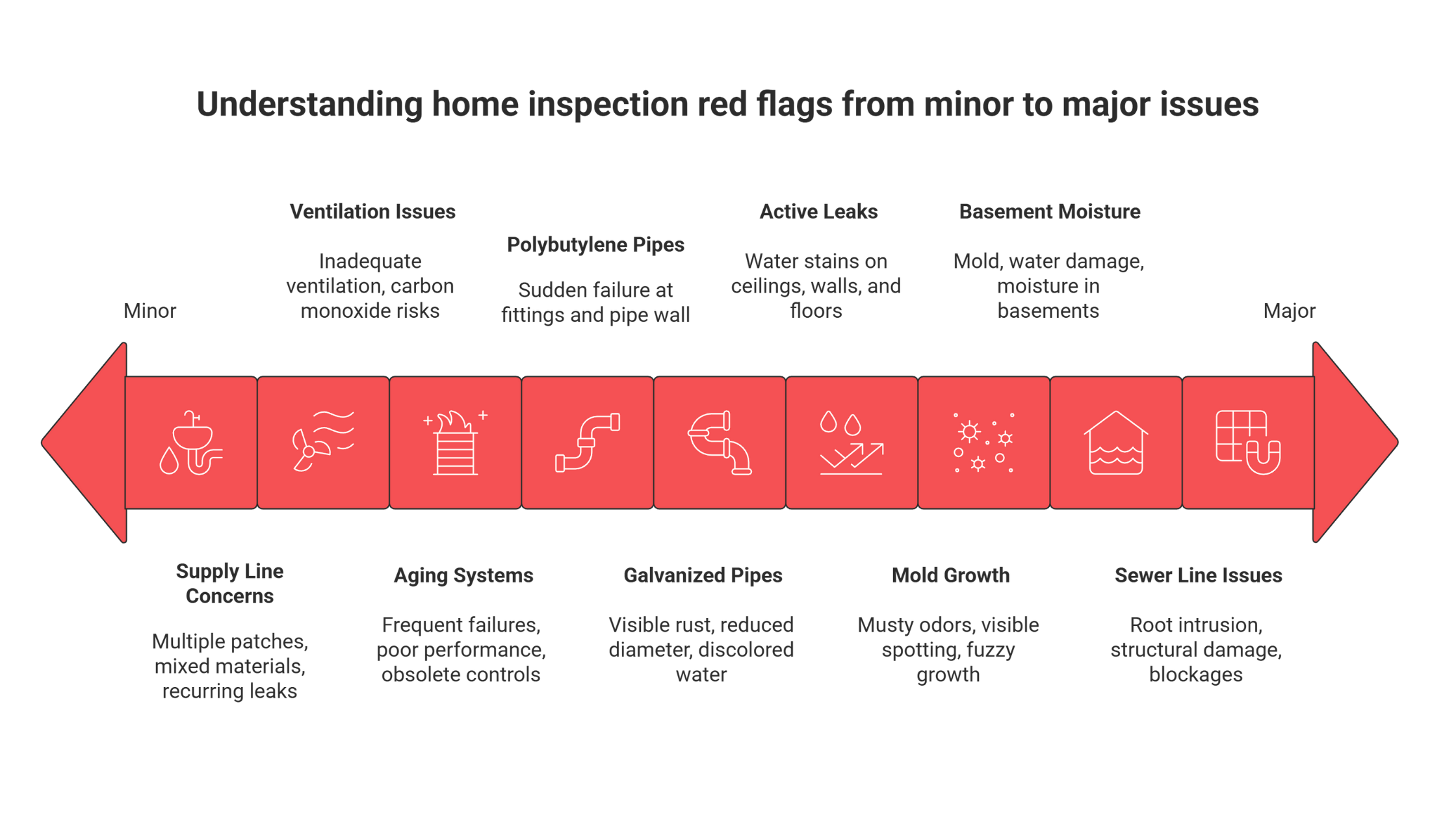
Polybutylene tubing in domestic water lines is treated as a high-risk material because of documented tendencies toward sudden failure at fittings and along the pipe wall, often without visible exterior warning. Professional checklists flag polybutylene as a red-flag material that may not safely tolerate modern maintenance methods and is commonly recommended for full replacement rather than repair.
Galvanized pipes in older homes are a major red flag when there’s visible rust, reduced diameter from internal scale, or discolored water. Corrosion and mineral buildup can significantly thin pipe walls, restrict flow, and predispose the system to leaks or rupture.
Whole-house repiping ranges roughly $3,500–$15,000+ for typical homes, varying by material. PEX installations run about $3,500–$7,000, while copper can reach $8,000–$15,000. Angi’s national data shows whole-house plumbing at $10,000–$20,000 for more extensive projects.
Sewer Line Issues and Drainage Failures
Sewer camera inspection standards highlight root intrusion through joints, structural damage from soil movement, misaligned or offset joints, pipe bellies holding wastewater, heavy corrosion in cast iron, and debris blockages as critical defects. These conditions can lead to chronic backups and potential sewage discharge into the home or yard, requiring repair or replacement rather than routine cleaning alone.
2025 inspection-industry examples describe sewer line collapses and replacements costing around $15,000–$20,000, not including related driveway/landscape repairs, after missed or declined sewer scopes. Sewer main line replacement from house to street typically runs about $3,000–$10,000+, depending on length, depth, and method.
Water Pressure Problems and Supply Line Concerns
Technical safety guidance warns that excessive operating pressure or pressure spikes can overstress weakened materials, blow out joints and gaskets, and cause catastrophic failures, especially when combined with aggressive cleaning pressures. Abnormal water pressure or unstable pressure is flagged as a condition that can rapidly turn minor defects into major leaks.
Multiple prior leak patches on the same line, mixed pipe materials spliced together, staining around old repair sites, and recurring leaks indicate piping is reaching end-of-life. Water service line repairs show $500–$4,000 for significant leaks, while complete line replacement averages about $1,700 and can exceed $10,000 depending on line length and depth.
Colorado’s high-altitude conditions and hard municipal water add complexity. Regional experts note that elevation lowers atmospheric pressure and changes how water and boiler systems behave, so homes often need correctly sized pressure-reducing valves and expansion tanks. Denver-area plumbers report harder water that accelerates scale in water heaters, fixtures, and piping, making regular descaling and access to shutoffs and cleanouts essential.
Water Damage, Mold, and Moisture Intrusion
Serious water intrusion, drainage, and mold are among the most common reasons buyers back out nationally, especially when remediation estimates reach five figures. EPA, CDC, and major building-science standards emphasize prompt identification and remediation of moisture problems.
Active Leaks and Water Staining Patterns
Active leaks can cause extensive damage if not addressed quickly. Inspectors look for water stains on ceilings, walls, and floors, which can indicate past or present leaks. Any building material that stays damp more than about 24–48 hours after a leak, spill, or condensation event is at significant risk for mold growth.
EPA and CDC state that if there has been “a lot of water damage” or you cannot dry and remove wet materials promptly, professional restoration following ANSI/IICRC S500 and S520 standards is recommended. CDC emphasizes drying wetted materials within 48 hours or removing them to prevent more intensive remediation needs.
Small to medium basement flooding averages $2,000–$8,000 for pump-out, drying, cleaning, and basic repairs. Modernize’s guide shows $2,000–$5,000 for flooded-basement cleanup and $1,500–$4,000 for clean-water restoration.
Mold Growth and Ventilation Deficiencies
Persistent musty odors, visible spotting, fuzzy growth, or staining that keeps returning after cleaning indicates an active moisture source and established mold colonization. EPA and CDC advise that if there’s extensive visible mold or moldy odor you cannot locate or correct, or if occupants have health concerns, a qualified remediation professional should be consulted.
Mold growth or water-damaged materials covering a large area (commonly referenced threshold of more than 10 square feet on walls or ceilings) or multiple rooms requires professional remediation. Mold remediation costs typically range $1,500–$5,000 for containment, HEPA filtration, removal, and clearance testing.
Basement and Crawl Space Moisture Issues
Denver-area red-flag lists highlight mold, water damage, and moisture in basements as major concerns that can be deal-breakers. JROC Properties stresses in our Colorado basement finishing guidance that Colorado basement work in 2025 requires expert planning, strict code compliance, and proactive moisture control due to local soil, snowmelt, and groundwater conditions.
Poor grading and short downspout extensions are a critical weakness in Colorado’s semi-arid but intense-event climate. Many Colorado homes have settled, flat, or negative grading and downspouts that discharge too close to the foundation, which becomes obvious when big snow followed by warm, sunny days dumps large meltwater volumes at the wall base.
Front Range-specific patterns include basement seepage during heavy rain or spring snowmelt where downspouts discharge near the foundation or concrete flatwork slopes toward the house, ice dams on poorly insulated/ventilated roofs in foothill and older Boulder/North Denver neighborhoods showing up as water stains on ceilings/walls, and snow and sun cycling leading to cracking in driveways and patios that inspectors flag because it contributes to drainage issues.
Basement waterproofing costs about $2,000–$8,000, including perimeter drains, sealing, and prep. French drain systems run $2,000–$5,000 and sump pump installs average around $1,200.
HVAC and Indoor Air Quality Red Flags
HVAC system condition directly impacts indoor air quality, comfort, and safety. Aging equipment, improper installation, and ventilation deficiencies are common inspection findings that can lead to costly replacements and health concerns. Denver-area inspectors report older or marginal furnaces as one of the regular major-ticket items alongside roofs and foundations.
Aging Systems Beyond Their Expected Lifespan
Residential split systems and furnaces are commonly treated as having an economic life of about 10–15 years. Inspectors and contractors flag older equipment showing frequent failures, poor performance, or obsolete controls as candidates for replacement rather than repair.
HVAC systems with significant defects or obsolete refrigerant levels at or beyond typical service life require careful evaluation. When equipment is aging and showing signs of stress, buyers should inquire about maintenance history and consider budgeting for replacement.
Improper Installation and Efficiency Problems
ACCA and ASHRAE emphasize that equipment and ducts must be sized by approved calculations rather than rules of thumb. Oversizing or undersizing is cited as a leading cause of short cycling, poor humidity control, hot/cold spots, and premature failure.
Colorado’s high-altitude conditions add complexity. Gas appliances lose about 4% input capacity per 1,000 feet elevation, so furnaces and water heaters installed without altitude derating or proper sizing may underperform. Inspectors report undersized or poorly installed condensers as frequent red flags, with rooms not reaching setpoint, limited supply to upper floors, and inadequate return air.
Typical 2024–26 red flags seen in Front Range reports include furnaces at or over typical 20–25-year life expectancy or with significant rust, combustion appliances not rated or adjusted for altitude (input BTU not derated), inadequate cooling on upper levels often in 2-story homes built in the 1990s–2000s with minimal duct design for A/C, and lack of whole-house humidification in Denver’s very dry climate.
Combined central AC and gas furnace replacement typically ranges $11,600–$14,100, averaging around $13,400 in 2026. Other contractor guides show roughly $10,000–$20,000 depending on efficiency, brand, and scope.
Ventilation Issues and Carbon Monoxide Risks
ASHRAE ventilation standards treat inadequate or inoperable ventilation systems as a critical deficiency, noting that systems not operated and maintained per design cannot reliably control indoor contaminants. Proper ventilation is crucial for maintaining indoor air quality and preventing hazardous conditions such as carbon monoxide buildup.
ACCA’s safety guidance states that when serious safety faults are identified (such as conditions that could lead to CO intrusion into occupied space), contractors must clearly document the issue, inform the customer, and recommend repairs. Building and housing codes require CO alarms in homes with fuel-burning appliances or attached garages.
Improperly vented furnaces, water heaters, stoves, or generators and cars idling in attached garages are key CO sources. Buyers should confirm presence and proper placement of CO detectors on every sleeping level and have a qualified heating contractor evaluate older fuel-burning appliances where inspection reveals rust, back-drafting, or prior alarm activations.

Environmental Hazards and Code Violations
Environmental hazards can pose serious risks to homeowners and should be thoroughly assessed during inspections. EPA, CDC, and HUD identify lead, radon, asbestos, and pest issues as core environmental health priorities for residential properties.
Asbestos, Lead Paint, and Radon Concerns
Federal law requires lead disclosure in most pre-1978 housing sales and gives buyers a 10-day period to conduct a lead paint inspection or risk assessment before being obligated under a purchase contract. HUD and EPA use lead-dust hazard standards of 5 µg/ft² (floors), 40 µg/ft² (sills), 100 µg/ft² (window troughs) to decide when abatement or further cleanup is needed.
Colorado is classified by EPA as a Zone 1 (high radon potential) state. CDPHE reports that nearly half of Colorado homes have radon levels above the EPA action level of 4.0 pCi/L and attributes more than 500 lung cancer deaths per year in Colorado to radon. Denver notes that about 50% of homes in Colorado have elevated radon, and Jefferson County reports similar figures.
Colorado Department of Public Health data show roughly 50–70% of tested homes in many Front Range counties exceed 4.0 pCi/L, often among the highest rates in the nation. As a result, many Colorado inspectors treat radon as a standard rather than optional test. Test results above 4.0 pCi/L routinely trigger a request for seller-paid mitigation (typically $1,200–$2,000) or a credit.
Order a short-term radon test for the lowest livable level during the inspection period. If results are at or above 4 pCi/L, negotiate professional mitigation as a condition of sale. JROC Properties maintains a Preferred Vendors list including specialized services like mold inspection and radon testing, giving buyers a ready-made roster of vetted professionals.
Asbestos in building materials from pre-1980s homes is another concern. EPA and HUD healthy homes guidance direct that suspect materials be tested by accredited asbestos professionals before renovation or demolition and that abatement or specialized enclosure be done when materials are friable or will be disturbed.
Safety Code Violations and Permit Issues
The most serious red flags are life-safety and structural violations, especially when tied to unpermitted work. These can block insurance coverage, prevent financing, and trigger large fines or even loss of the certificate of occupancy.
Unengineered removal of load-bearing walls, beams, or joists without permits can cause partial collapse and water intrusion. Officials flag unpermitted structural work as a top concern because it often hides in finished spaces and can require demolition, engineered repair, and retroactive permits.
DIY or unpermitted panel upgrades, added subpanels, aluminum wiring extensions, and missing GFCI/AFCI protection are common violations that significantly increase fire risk. National Electrical Code violations can lead to denied claims if a fire is traced to non-code work.
Disabled or missing smoke/CO alarms, removed sprinkler heads, missing fire-stopping, blocked egress routes, and non-rated doors between garages and living spaces all directly undermine life safety. Fire marshals and building departments treat these as immediately hazardous conditions.
Pest Infestations and Wood-Destroying Organisms
Pest infestations, particularly from wood-destroying organisms like termites, can cause significant damage. CDC, EPA, and HUD highlight mold, dust mites, cockroaches, rodents, and excess moisture as major asthma triggers and contributors to respiratory illness.
HUD’s healthy housing codes prohibit standing water, chronic moisture, roof and plumbing leaks, and pest infestation, calling for integrated pest management instead of heavy pesticide use. Treat visible mold, persistent musty odor, signs of roof or plumbing leaks, or evidence of cockroaches and rodents as triggers for further inspection and repair estimates before closing.
Understanding Repair Costs and Financial Implications
Understanding the financial implications of inspection findings is crucial for Colorado buyers navigating 2026’s market. Repair costs can vary significantly based on the severity of issues identified, and JROC Properties helps buyers evaluate whether problems are manageable or represent deal-breaking expense.
System/Issue | Typical Repair Cost | Replacement Cost |
Foundation (minor cracks) | $300–$800 per crack | — |
Foundation (major structural) | $15,000–$30,000+ | — |
Roof (minor repairs) | $400–$1,900 | $12,000+ |
Electrical panel upgrade | $800–$4,000 | — |
Full house rewiring | $5,000+ | — |
Sewer line | — | $3,000–$10,000+ |
Whole-house repiping | — | $3,500–$15,000+ |
HVAC system | — | $11,600–$14,100 |
Basement waterproofing | $2,000–$8,000 | — |
Mold remediation | $1,500–$5,000 | — |
How Red Flags Affect Home Value and Resale
Red flags identified during inspections can significantly impact a home’s value and resale potential. JROC Properties emphasizes in our home improvement ROI consulting that strategic, modest updates tend to outperform full luxury renovations on ROI, and financial decision-making should prioritize necessary repairs and local market standards before cosmetic overhauls.
Properties needing major structural or foundation work are red flags that can derail negotiations, so such issues are often better addressed before listing to avoid scaring off buyers and triggering steep discounts. Our data shows that in Colorado, garage door replacement can return ~193.9% ROI and steel entry doors ~188.1%, often adding more value at resale than they cost because buyers heavily reward curb appeal, security, and energy efficiency.
Minor kitchen remodels with cabinet refacing and energy-efficient appliances typically deliver ~75–96% ROI and have been linked to a median home price increase of about 17% in Colorado, while new roofs recoup ~68% and help homes sell for ~2.5% more than similar properties without them.
How to Prioritize Multiple Red Flags: A Decision Framework
Once you have the inspection report, the challenge isn’t understanding individual defects but deciding how to weigh them together and where to invest your limited negotiation capital. Here’s how to prioritize when you’re facing multiple issues.
Tier 1: Walk-Away Threshold Issues
These are combinations that fundamentally change what you’re buying and typically justify terminating the contract:
Active structural movement + repair costs exceeding $20,000 + seller refusal to negotiate. When you have measurable foundation settlement (doors sticking, visible gaps, cracks wider than 1/4 inch with evidence of ongoing movement) and multiple contractor bids confirm major underpinning or engineering work, and the seller won’t budge, you’re looking at a property that will be difficult to insure, finance, and resell.
Safety hazards requiring immediate correction + system end-of-life. Federal Pacific panel with evidence of breaker failure + aluminum wiring + 20-year-old furnace with cracked heat exchanger creates a compounding risk profile. Each issue alone might be negotiable, but together they represent immediate danger and imminent capital expense.
Cumulative repair costs exceeding 10% of purchase price when you’re stretching your budget. If total documented repairs (foundation $18K, roof $14K, electrical $6K, HVAC $12K = $50K on a $450K home) exceed 10% of purchase and you’ve already committed your reserves to down payment and closing, even “fixable” issues justify walking because you have no financial cushion for surprises or cost overruns.
Tier 2: Aggressive Negotiation Territory
These warrant full replacement/credit requests, not minor concessions:
Federal Pacific or Zinsco panels, aluminum wiring, knob-and-tube still active. These are documented fire hazards, not preference items. Request full panel replacement or complete rewiring as a condition. If the seller balks, use the insurance angle: many carriers won’t write or renew coverage without remediation, making this a lender and resale problem, not just your preference.
Roof or HVAC system past its economic life with documented performance issues. A 22-year-old roof showing active leaks and granule loss, or a 20-year-old furnace that failed inspection for cracked heat exchanger, isn’t a “repair” situation. Request full replacement credit equal to contractor bids plus 10–15% contingency, not a token $2,000 off the price.
Documented health hazards: active mold, radon >4.0 pCi/L, lead dust above EPA action levels. These trigger federal disclosure and remediation standards. Negotiate professional mitigation as a seller-paid condition, not a DIY credit. If the seller refuses, walk (these issues will reappear for the next buyer and tank your resale).
Tier 3: Minor Negotiation or Accept and Plan
Deferred maintenance items under $5,000 total. Worn faucets, minor siding repairs, aging water heater at 8 years but still functional, cosmetic issues. These are planning items, not deal points. Budget for them in your first 1–3 years; don’t waste negotiation capital here.
Single moderate issues with clear scope and cost. One area of water staining from a roof leak that’s been repaired, polybutylene plumbing limited to one bathroom, minor foundation crack with no evidence of movement. Get a bid, request a credit equal to 75–90% of the estimate, and move on if the seller agrees. If they won’t, decide whether you can absorb the cost and still feel the deal is fair.
Assessing Cumulative Risk
Here’s the calculus: If total repair costs exceed your emergency fund plus 5% of the purchase price, you’re buying a project, not a home. Assume every contractor bid will run 15–20% over due to hidden conditions discovered during work. If that math still leaves you with reserves, proceed. If not, recognize you’re one surprise away from financial distress.
In Colorado’s 2026 market, homes with clean inspections are moving in under 10 days. If you’ve found major red flags, you have more leverage than you think because the next buyer will find the same issues and the seller knows it. Use that reality to your advantage, but also recognize when the property is fundamentally mispriced for its condition.
Making Decisions After Discovering Red Flags
Once red flags are identified during inspection, buyers must make informed decisions about how to proceed. Understanding your options helps you navigate negotiations and determine the best course of action for your specific situation and budget.
When to Negotiate Repairs or Price Reductions
About 20% of buyers waived the inspection contingency in recent 12-month periods, meaning roughly 80% kept it and had the ability to negotiate based on findings. In August 2025, 15.1% of homes under contract were canceled, the highest August share since at least 2017, with a survey of Redfin agents showing 70.4% said home inspection or repair issues were the cause. This data shows that inspection issues are a leading cause of contract termination, but many deals still proceed when buyers and sellers can reach agreement on repairs or credits.
JROC Properties’ buyers guide notes that inspections almost always turn up issues. The focus should be on identifying major structural, safety, or system problems versus minor defects, then using repair requests, seller credits, or price adjustments to address big items rather than walking away by default.
Instead of arguing over the inspection in the abstract, anchor your request to objective evidence. Start with a comparative market analysis of similar homes in similar condition, not perfect ones. Gather at least one licensed contractor bid per major issue. Translate findings into a specific, itemized ask.
If defects are moderate and fixable, request price reduction or repair credit approximately equal to verifiable repair costs plus a reasonable contingency (often 10–20% buffer). If defects are extensive or poorly documented, prioritize larger price reduction or credit over seller-performed work, so you control quality and scope.
When to Walk Away from the Deal
Run a final filter: Does the deal still reflect the property you thought you were buying? If the scope of undisclosed problems is so large that the character of the purchase has changed (from “move-in ready” to “major rehab”), buyer-advocate and Realtor guidance treats that as a legitimate basis to cancel rather than endlessly renegotiate.
If fixing discovered issues would consume the cash reserves you earmarked for safety and living expenses, or push you beyond your agreed risk tolerance, the professional recommendation is to walk away and wait for a cleaner deal rather than forcing this one to work.
JROC Properties emphasizes clarifying your “must-haves” and financial limits in advance, then comparing the cost and risk of fixing inspection issues to the home’s value, location, and long-term fit. If problems significantly exceed your comfort level or can’t be resolved through negotiation, that’s the point to move on.
Getting Specialist Inspections for Major Concerns
ASHI, InterNACHI, and state Standards of Practice state that home inspections are visual and not technically exhaustive. When an inspector observes notable foundation movement, major cracks, sagging or damaged framing, or prior structural modifications outside their competence, they’re expected to report the defect and recommend further evaluation by the appropriate professional, such as a structural engineer.
Standards require inspectors to visually inspect roof coverings and report observed indications of active leaks, but they’re not required to walk unsafe roofs, access concealed components, or provide technically exhaustive evaluation. If the inspector notes active or past leakage, widespread deterioration, or cannot fully access the roof, they typically recommend further evaluation by a qualified roofing contractor.
ASHI and InterNACHI Standards explicitly state that home inspectors aren’t required to determine the presence of mold or environmental hazards. When visible staining, musty odors, elevated moisture readings, or prior water damage are found, inspectors commonly document the condition and recommend further evaluation or testing by a mold or indoor-air-quality specialist.
Because inspectors aren’t required to evaluate code compliance, environmental hazards, or complex HVAC or electrical design, they should refer buyers to relevant specialists (licensed electrician, HVAC contractor, chimney specialist) when defects, safety hazards, or access limitations are found.
Working Effectively with Your Home Inspector
Effective communication with your home inspector is essential for maximizing the value of the inspection process. Here’s how to focus your time and questions on what matters most.
Critical Questions to Ask During the Inspection
“What is the scope of this inspection, and what isn’t included?” InterNACHI’s Standards of Practice define a home inspection as a non-invasive, visual examination of accessible areas and list many things the inspector isn’t required to determine. This protects you from false assumptions about what was checked and helps you decide if you need specialized inspections for sewer scope, mold, radon, structural engineering, or other concerns.
“Which issues you found are material defects or safety hazards, and which are routine maintenance?” Asking this forces the inspector to clearly separate major versus minor issues so you know what truly affects safety, financing, insurance, and negotiations versus what is normal wear you can plan to maintain.
“Of the problems you found, which ones are urgent and should be addressed before closing, and which can wait?” Prioritization helps you and your agent focus repair requests on critical, time-sensitive items like active leaks, structural movement, and major electrical hazards rather than cosmetic or minor issues.
“Based on what you saw, what further specialist evaluations or tests do you recommend?” A good inspector will tell you when to bring in licensed trades or specialists so you don’t rely on a general inspection for issues that need expert diagnosis and cost estimates.
Red Flags About the Inspector Themselves
Colorado has no state licensing, standards of practice, or direct buyer protections specific to home inspectors administered by the Colorado Division of Professions and Occupations. Colorado is an unregulated state for home inspectors at the state level, so buyers must independently verify training, exams, and association membership instead of assuming any state-vetted credential.
Red flags about the inspector include reports missing required basic information and descriptions, failure to inspect or describe major accessible systems without clearly stating limitations, vague or conclusory language instead of factual and clearly bounded descriptions, and minimizing conflicts-of-interest or promising repairs on items found.
Professional standards treat inspections as independent, unbiased evaluations. Inspectors generally shouldn’t use the inspection to sell repair services on the same property. Since there’s no Colorado home inspector board or license to discipline, dissatisfied buyers generally must rely on civil claims and general consumer-protection law, not an administrative complaint process tailored to home inspections.
Conclusion: Protecting Your Colorado Home Investment
Understanding home inspection red flags empowers you to make confident, informed decisions in Colorado’s 2026 real estate market. From foundation settlement and electrical hazards to radon testing and moisture control, the issues we’ve covered represent the difference between a sound investment and a money pit. JROC Properties has guided hundreds of buyers through inspection findings, helping them distinguish between negotiable repairs and deal-breaking defects while securing fair concessions and protecting long-term value.
Remember that inspection reports aren’t pass/fail grades but strategic tools for negotiation, budgeting, and risk assessment. Focus your energy on material defects affecting safety, structural integrity, and habitability rather than cosmetic concerns. Use documented contractor bids to anchor repair requests, bring in specialists for major structural or environmental concerns, and walk away when problems fundamentally change the property’s character or exceed your financial comfort zone.
Ready to navigate your next Colorado home purchase with expert guidance? Contact JROC Properties today to work with professionals who understand local inspection challenges, know which vendors to trust, and have helped buyers successfully close deals across Denver, Boulder, Longmont, and surrounding markets. Let us turn inspection findings into negotiating leverage and peace of mind.